

Bending Parts Exporter: Precision Custom Metal Forming for Global Manufacturers
2026-11-16
Sourcing bending parts that hold tolerances across continents shouldn't feel like a gamble. Yet for many global manufacturers, inconsistent custom metal forming still leads to delayed lines and costly rework. BOYIKUN takes a different route—pairing precision tooling with export processes designed around international timelines. The sections ahead unpack what actually separates a dependable bending parts exporter from the rest, and how to spot the difference before your next order lands. If you've ever wondered why some suppliers nail complex geometry while others miss the mark by millimeters, this is for you.
Complex Bends, Zero Guesswork
Most bend sequences fall apart the moment a part has more than one tricky angle. This approach maps every rotation, tangent point, and springback factor before the first piece touches the die. You get a clear set of coordinates and stop points, so the operator isn’t leaning on feel or reworking scrap.
The real difference shows up on multi-plane layouts. Instead of guessing how a tube will twist after the third bend, the geometry is resolved ahead of time. Each bend is checked against the actual material thickness and radius limits, which keeps the finished shape within tolerances that usually drift on manual setups.
What used to take a few test runs now happens in one pass. The numbers are already dialed in, and any adjustment is small enough to handle at the machine without recutting stock.
Alloys That Perform, Not Just Form
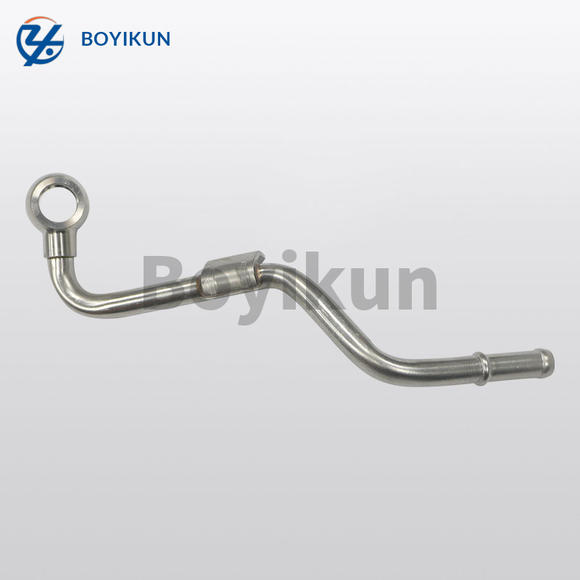
Most people think of alloys in terms of their look—shiny, smooth, maybe a certain color. But the real value lies in what happens when you put them to work. A well-engineered alloy doesn't just sit there looking pretty; it withstands stress, resists corrosion, and keeps its shape under conditions that would break lesser materials. That's the difference between a decorative metal and a functional one.
Take a simple bracket, for instance. You could cast it from a cheap aluminum blend and it would polish up nicely. But put that same bracket under repeated vibration or temperature swings, and tiny cracks start to form. A performance-focused alloy, on the other hand, is designed from the start to handle those loads. The composition isn't chosen for appearance—it's chosen for fatigue strength, thermal stability, and long-term reliability.
This principle applies everywhere from aerospace fasteners to medical implants. The best alloys are often the ones nobody notices, because they simply keep doing their job year after year. Form matters, sure, but it's just the surface. What counts is what's underneath—the carefully tuned blend of elements that turns a piece of metal into a dependable component.
Tooling That Keeps Your Tolerances Tight
Precision doesn't happen by accident. Every fixture, insert, and clamp in our shop is dialed in with the same obsession we apply to your final part. We treat tooling as a living system—constantly measured, adjusted, and replaced before it drifts out of spec. That means thermal growth gets compensated for, tool wear is predicted rather than discovered, and your ±0.0005" tolerance stays exactly where it belongs: in the part, not in the scrap bin.
The real difference is in the details nobody sees. We use custom-ground soft jaws that hug thin-wall sections without distortion, and balanced toolholders that kill vibration before it can smear a surface finish. Every setup gets a quick capability check on a CMM before the spindle even spins up. If a tool can't hold the number, it doesn't go in the machine—period.
What this buys you is boring in the best way. No phone calls about parts that are 'almost right.' No last-minute rework that eats your schedule. Just a steady stream of components that drop into your assembly like they grew there, batch after batch, because the tooling behind them never got a chance to wander.
Inspection at Every Stage, Not Just Final Audit
A final audit catches defects only after they have already been baked into the product, which turns quality into a post-mortem exercise. By inspecting at each stage, you force small corrections while they are still cheap and local. A weld that gets checked before painting, a component that is measured before assembly, or a code module that is reviewed before integration stops a minor issue from snowballing into a costly recall.
This approach also changes how teams think about ownership. When inspection happens throughout the process, workers and suppliers stop treating quality as someone else’s job downstream. They start building to pass the next gate, not just the final one. Over time, that shared rhythm reduces rework, shortens lead times, and makes the final audit a confirmation rather than a discovery.
The real payoff is not just catching errors earlier. It is the ability to trace exactly where a process drifted, because every stage leaves its own evidence trail. That granular visibility lets you adjust a single step instead of overhauling an entire production line when something goes wrong.
Export Logistics Without the Headaches
Shipping goods overseas can quickly turn into a maze of customs forms, carrier delays, and surprise fees. The trick is to stop treating export logistics as an afterthought and start building a simple, repeatable process. For most small and mid-sized businesses, that means choosing a freight forwarder who actually answers the phone, consolidating your documentation ahead of time, and getting real-time visibility on every shipment instead of chasing status updates by email.
A practical workflow looks like this: classify your products correctly once, then reuse that data for every quote and booking. Keep a digital folder with commercial invoices, packing lists, and any certificates of origin ready to go. When a new order comes in, you're not scrambling—you're just changing the destination and weight. This removes the last-minute panic that leads to costly air freight upgrades or missed vessel cutoffs.
Finally, don't assume all carriers are equal. Test two or three lanes with different partners and measure not just the rate, but the time from booking to departure, the accuracy of tracking updates, and how quickly issues get resolved. Once you find a lane that runs smoothly, lock in a quarterly review instead of renegotiating every month. That way, export logistics becomes a background operation—reliable, predictable, and out of your way.
Your Design, Our Bending Expertise
Your drawings rarely survive first contact with a bend radius—and that's where we come in. Instead of treating your CAD file as gospel, our press brake and tube bending teams read the intent behind each flange, offset, and sweep. We'll flag the inside radius that will crack on a 2mm cold-rolled sheet, suggest a grain direction tweak, or re-sequence the bends so your welded corners actually meet. You get a working prototype, not a dimensionally perfect part that fights assembly.
Material memory is the quiet variable. Aluminum wants to spring back; stainless grabs the tooling if the die clearance is too tight; high-strength steel laughs at standard v-openings. We keep a running library of bend deductions and springback corrections for the alloys we run most—so your repeat orders don't inherit yesterday's trial-and-error. When a radius or angle falls outside what our standard tooling can hold, we'll say so early, and cut a custom punch or roller set rather than forcing the part into a bad set-up.
The best bent parts come from a conversation, not a hand-off. Send us a marked-up print, a rough sketch, or even a bent coat hanger that shows the profile you're chasing. We'll translate that into flat pattern realities, advise on bend reliefs before the laser cuts, and batch the prototypes so you can test fit, load, and weld sequence without committing to full production. Your design stays yours; we just make it hold its shape.
FAQ
We handle press brake bending, roll bending, rotary draw bending, and custom profile bending, with thicknesses from 0.5 mm to 25 mm depending on the material.
Each job is programmed with CAD/CAM software and verified on CNC press brakes using laser-measured angle correction, holding tolerances down to ±0.1 mm on critical dimensions.
Automotive, agricultural equipment, material handling, renewable energy, medical devices, and architectural metalwork, among others—often for brackets, frames, housings, and structural supports.
Yes. We run single-piece prototypes with quick tooling setups, and scale to multi-thousand-part production orders without changing the bend sequence or quality checks.
We bend carbon steel, stainless steel, aluminum, copper, brass, and some titanium grades. Our engineering team reviews your load, finish, and corrosion requirements before recommending the right alloy and thickness.
Parts are wrapped in anti-corrosion film, separated by custom foam or plywood dividers, and crated to prevent distortion during ocean or air freight, with all necessary export documentation managed in-house.
We perform first-article inspection on every new part number, then periodic in-process checks using CMM and optical comparators, and issue a dimensional report with each shipment if requested.
Yes, we coordinate laser cutting, punching, welding, machining, and surface finishing like powder coating or zinc plating, so you receive a ready-to-install component rather than a bare bend.
Conclusion
When a drawing lands on our desk with tight radii, asymmetric flanges, or material that fights back, the first question is rarely "can it be done?" but "how do we hold the shape through every hit?" Complex bends stop being guesswork once the tooling is designed around the actual springback of the alloy, not a generic table. We work with stainless grades, high-strength steels, and aluminum tempers that behave differently under the same press. The tooling itself gets reworked after trial runs—shims, crowning adjustments, and local relief cuts—because a 0.2 mm drift in the third bend can scrap a part that looked perfect after the first two. That is the difference between forming metal and controlling it.
Inspection happens at the press, not just on a CMM days later. Operators check critical dimensions during the run with hard gages and surface plates, so a trend is caught before it becomes a lot rejection. On the export side, we crate parts with the same attention: anti-corrosion films, custom dunnage, and documentation that matches exactly what is in the box. Your design stays yours; our bending engineers will suggest alternate bend sequences or relief notches only when it reduces cost without touching function. No re-explaining, no lost revisions—just a clean handoff from your CAD to a formed part that fits where it is supposed to, whether it is headed to a plant in Ohio or a port in Rotterdam.
Contact Us
Contact Person: Xianchen Hu
Email: [email protected]
Tel/WhatsApp: 86-13248645200
Website: https://www.hexnb.com/