

Best 20-Inch Cutter Suction Dredger Company for Reliable Dredging Operations
2026-09-08
When a 20-inch cutter suction dredger is your workhorse, reliability isn't a nice-to-have—it's the difference between hitting project milestones and watching deadlines sink. Yet many operators settle for underpowered pumps, thin-hulled pontoons, or service that vanishes after the sale. That's where YaKai Dredger changes the equation. In this guide, we break down why this specialist keeps earning the top spot for heavy-duty dredging—from engineering choices to real-world fleet results.
Why 20 Inches Is the Sweet Spot for Inland and Coastal Dredging
A 20-inch dredge sits in a practical zone where production and portability overlap. Smaller 12- or 14-inch models struggle to keep pace on medium-sized contracts, while 24-inch and larger units bring higher mobilization costs, deeper draft, and more crew. A 20-inch cutter suction dredge can still be moved by truck in most regions without major road permits, yet it delivers enough pump capacity to keep a hydraulic pipeline moving at a useful rate in sandy and silty material.
Inland operators value that a 20-inch dredge can enter shallow canals, borrow pits, and reservoirs without extensive disassembly. Draft typically stays low enough for launching from modest ramps or temporary slipways. Coastal contractors find the same platform handles marina basins, small navigation channels, and beach nourishment feeder lines. The discharge diameter pairs well with standard 20-inch HDPE pipe, so setting up a long floating or submerged pipeline doesn’t require exotic fittings or oversized booster stations.
The sweet spot also shows up day-to-day in fuel burn and labor. It consumes noticeably less diesel than a 24-inch machine but outperforms smaller dredges on a cost-per-cubic-yard basis once the pipeline length exceeds a few hundred meters. Maintenance remains manageable with a small crew, and wear parts are widely available. That balance keeps bid prices competitive without forcing project managers to sacrifice production or schedule reliability.
What the Best Builders Do Differently With Wear Plates and Liners
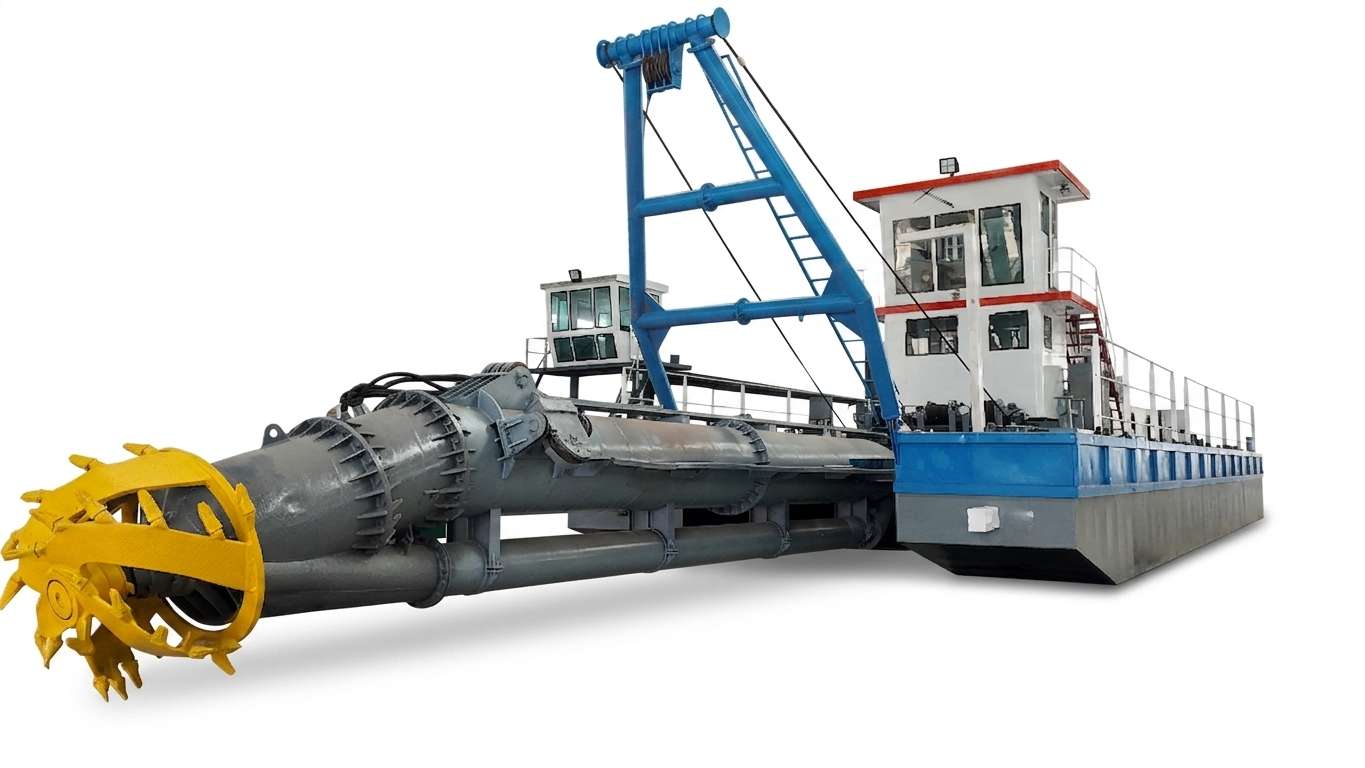
Top builders treat wear plates and liners as an engineered system rather than a commodity purchase. They map wear patterns across the equipment before ordering anything, measuring localized abrasion, impact angles, and temperature swings. That field data drives choices in alloy composition, hardness gradients, and plate thickness, so high-wear zones get extra protection without adding dead weight where it isn't needed.
Another difference shows up in how they handle installation and fit-up. Instead of forcing generic rectangular plates into curved chutes or hoppers, these builders cut, bevel, and pre-form liners to match the existing geometry. They also sequence the fastening or welding to minimize distortion and leave predictable gaps for thermal expansion. The result is fewer stress cracks, less material hang-up, and easier replacement later.
Maintenance habits set the best teams apart as well. They keep a simple wear log and replace liners on a schedule based on actual thickness measurements, not a calendar guess. By documenting which sections fail first, they adjust materials and attachment methods in the next round, gradually extending service life instead of repeating the same mistake.
Cutter Suction Dredger Downtime: The Maintenance Mistake That Costs Weeks
Most cutter suction dredger outages don’t start with a catastrophic failure—they begin quietly in the engine room when a routine oil sample gets filed without review, or when a worn cutter tooth is ignored one more shift. That deferred ten-minute fix becomes a cracked bearing housing, and suddenly the dredge is tied up for two weeks while the pump is pulled and rebuilt. The mistake isn’t lack of maintenance; it’s treating maintenance as a checklist instead of a condition-based system.
On many CSDs, the ladder pump and gearbox get attention, but the auxiliary systems—hydraulic power packs, jetting water lines, and spud carriage rollers—are left on a fixed calendar. When a seal degrades on a jet pump, the pressure drop is gradual; operators compensate with higher RPM, masking the issue until the impeller is beyond repair. Then you’re ordering a new part with a three-week lead time and paying crew to stand by. A daily two-minute visual check and weekly vibration reading would have caught it at a fraction of the cost.
The other common pitfall is welding over cracks in the cutter head or ladder without addressing why the crack formed. Misalignment from a bent ladder or unbalanced cutter causes repeated stress; patching it just moves the failure point further up the structure. When the final break happens during a high-production window, you lose not only the repair days but the entire project schedule slip. The weeks lost aren’t from the repair itself—they’re from the unplanned nature of it.
How to Tell If a Dredger's Pump Curve Is Honest or Inflated
A dredger’s pump curve is supposed to be a straightforward read: flow rate on one axis, head on the other, and a clean line showing what the pump can actually do. But in practice, those curves are often dressed up to look better than they are. One of the first tells is whether the curve ends abruptly or trails off into a vague smudge. Honest curves include the full operating range, including the low-efficiency edges where cavitation starts to chatter and the pump struggles. Inflated curves tend to cut off right at the sweet spot, hiding the ugly drop-off that would otherwise reveal real-world limits.
Another red flag is the lack of supporting data for the curve itself. A trustworthy pump curve is backed by test points, usually plotted as small dots or squares along the line. If you see a smooth, perfectly drawn parabola with no test points, or if the test points cluster suspiciously close to the advertised best efficiency point, someone likely smoothed over the rough edges. Ask for the raw test sheet or a video of the pump running at multiple speeds. Reputable manufacturers won’t flinch at that request; the ones with inflated curves will suddenly go quiet.
Finally, compare the claimed efficiency against the pump’s physical size and impeller design. A small dredge pump claiming 85% efficiency at a high head is likely stretching the truth, because efficiency is ultimately bounded by hydraulic geometry and clearance tolerances. Real-world dredging involves abrasive slurries that wear down clearances quickly, so even an honest curve loses accuracy after a few hundred hours. If the curve looks too perfect on paper and doesn’t degrade with wear, that’s not engineering—that’s marketing.
Standard Features That Should Be Non-Negotiable on a 20-Inch Dredger
A 20-inch dredger only earns its keep if certain core attributes are built in from day one. You want a hull that can take the constant vibration and abrasive slurry without flexing or cracking, so look for heavy-gauge steel plate with full-length longitudinal stiffeners and closely spaced transverse frames. The pump should be a heavy-duty centrifugal unit matched to the engine power curve, with replaceable wear liners in both the casing and impeller. If the manufacturer treats wear parts as optional, walk away.
Control systems are another place where shortcuts show up fast. A proper 20-inch dredger needs hydraulic winches with proportional control, not jerky on-off levers, and the ladder hoist should have a mechanical locking pawl so the weight isn't hanging on hydraulic pressure alone. Spud systems need to be robust enough to hold position in current without creeping, and the operator's cab should give clear sightlines to the cut, the discharge, and both spuds. If you have to stand up or rely on cameras to see the work, the layout is wrong.
Instrumentation often gets trimmed to hit a price point, but that's a false economy. At minimum you need a production meter on the discharge line, vacuum and pressure gauges at the pump, and a flow sensor that actually survives the slurry. Engine telemetry should be visible at the operator station, not buried in a separate compartment. And don't accept a dredger without a properly sized ladder pump seal water system — running the gland dry for ten minutes will destroy a shaft sleeve faster than any rock in the pipeline.
From Hull to Discharge: Where Reliability Is Won or Lost
The journey of a bulk carrier from the moment its hull first touches open water to the final offloading at port is a chain of small, unglamorous decisions. Rust blooming on a hatch cover, a worn gasket on a ballast line, or a misjudged trim during discharge can cascade into delays that no amount of favorable weather can undo. Reliability here isn't a single heroic act—it's the quiet accumulation of checks that happen long before the crane swings over the hold.
Veteran operators know that the real risks hide in the transitions: the shift from steaming to maneuvering, the first lift of a grab bucket, the moment cargo moisture begins to shift beneath a sealed deck. Each handoff between crew, equipment, and shore-side teams is a potential fracture point. A ship that loads in four ports and discharges in one has already survived a dozen such seams; the one that breaks is rarely obvious from the bridge.
What separates dependable tonnage from the rest isn't pedigree or age—it's how honestly the gaps between hull and discharge are acknowledged. Corrosion under the deck plates, the wrong viscosity of grease on a winch, a hatch sealing strip that's been 'almost good enough' for three voyages: these are the threads that unravel when the schedule tightens. Reliability is won by the crew member who calls out a half-centimeter crack before it becomes a surveyor's finding, and lost by the assumption that yesterday's performance guarantees today's.
FAQ
A 20-inch dredger balances high output with manageable mobilization costs. The cutter head handles compacted soils, clay, and even soft rock, while the discharge diameter supports efficient slurry transport over longer distances.
Look for a track record of completed projects similar to yours, transparent specs on pump and ladder systems, and readily available replacement parts. Ask about their in-house engineering team and whether they offer on-site commissioning support.
They work well for port maintenance, land reclamation, channel deepening, sand mining, and environmental cleanup. The 20-inch size gives enough power for serious production without the logistics burden of larger vessels.
Focus on dredging depth capacity, cutter drive power, pump material and impeller design, automation level of the control system, and hull type—portable versus dismountable. Also check fuel consumption per cubic meter.
Even a well-built dredger will need parts and troubleshooting. A company with regional service hubs, quick-response technicians, and training for your crew prevents small issues from becoming costly downtime.
Yes, but you need a machine with adequate cutter horsepower and tooth configuration. Some companies offer interchangeable cutter heads for different soil types, which gives flexibility when ground conditions vary across a site.
Request a detailed performance curve, list of recent clients with contactable references, spare parts inventory policy, warranty terms covering hydraulic and electrical systems, and whether they conduct factory acceptance tests before shipping.
Many are designed as knock-down or containerized units that can be disassembled for road or sea transport. Check the maximum segment weight and whether the manufacturer provides assembly supervision at the new site.
Conclusion
A top-tier 20-inch cutter suction dredger builder earns its reputation by understanding that this size hits the practical balance between shallow inland work and tougher coastal jobs. The best companies don't treat 20 inches as just another model—they design the hull, ladder, and swing system around the specific torque and flow demands that keep a dredge productive without constant repositioning. They also make wear protection a core part of the build: hardened plates in the cutterhead area, replaceable liners in the pump casing, and abrasion-resistant piping from suction mouth to discharge point. Without those details, operators lose weeks to unplanned downtime, often because a liner wasn't inspected or a pump curve was read too optimistically. Honest builders provide tested performance data instead of inflating flow numbers that collapse under real slurry conditions.
Reliability isn't won only in the pump room. It starts at the hull and carries through every weld, seal, and discharge connection. A trustworthy 20-inch dredger company treats certain features as non-negotiable: a robust spud carriage system, a properly sized auxiliary engine, accessible grease points, and instrumentation that gives the operator real-time wear and pressure feedback. They also build with future maintenance in mind, because a dredger that's hard to service will sit idle. When you compare builders, look past the brochure numbers and ask where the wear plates are placed, how the pump curve was measured, and how long the discharge line is rated to last under continuous slurry flow. These are the quiet engineering choices that separate a reliable dredging operation from one that fights breakdowns all season.
Contact Us
Contact Person: Nancy
Email: [email protected]
Tel/WhatsApp: (+86) 13869631558
Website: https://www.yakaidredger.com/