

China PCB Assembly Insights for Reliable Electronics Production
2026-11-26
Most China PCB assembly discussions stop at price per board, but that misses what actually keeps production stable. Reliable electronics depend on earlier choices: layer stack-up, DFM checks, component sourcing, and how quickly a partner flags deviations before they reach the line. This post pulls together practical insights for buyers and engineers who need repeatable results rather than one good batch. Drawing on real production experience from Sanjing, we look at where projects commonly drift and what to watch before you place an order.
Reading a Chinese Assembly Floor Before the First Panel Moves
A still assembly floor says more in ten minutes than most shift reports manage in ten pages. Tape marks peel at the edges where carts get parked too fast. A few zip ties sit in the corner near station three, not swept up but not in anyone’s way either. Boxes of M6 bolts have been opened from the wrong end, and someone wrote the count on the flap with a marker that was already dying.
Look at the spaces between workbenches before the first panel starts moving. The aisles are wide enough for a pallet jack but not so wide that people treat them as storage. One roller track has a shim under its left leg made from folded cardboard. It has been there long enough to flatten into a permanent wedge. That is not a defect. It is a small adjustment nobody bothered to hide, which tells you people here fix things for the shift they are actually working, not for a photo.
What you do not see matters just as much. There are no loose rubber gloves on the floor, no half-empty water bottles lined along the conveyor frame, no stacks of rejected panels waiting for a decision. The floor has not been dressed up; it has just been used. The first panel will move through this space in a few minutes, and the line already knows where it is going.
Design Details That Decide Whether a Board Survives Its Enclosure
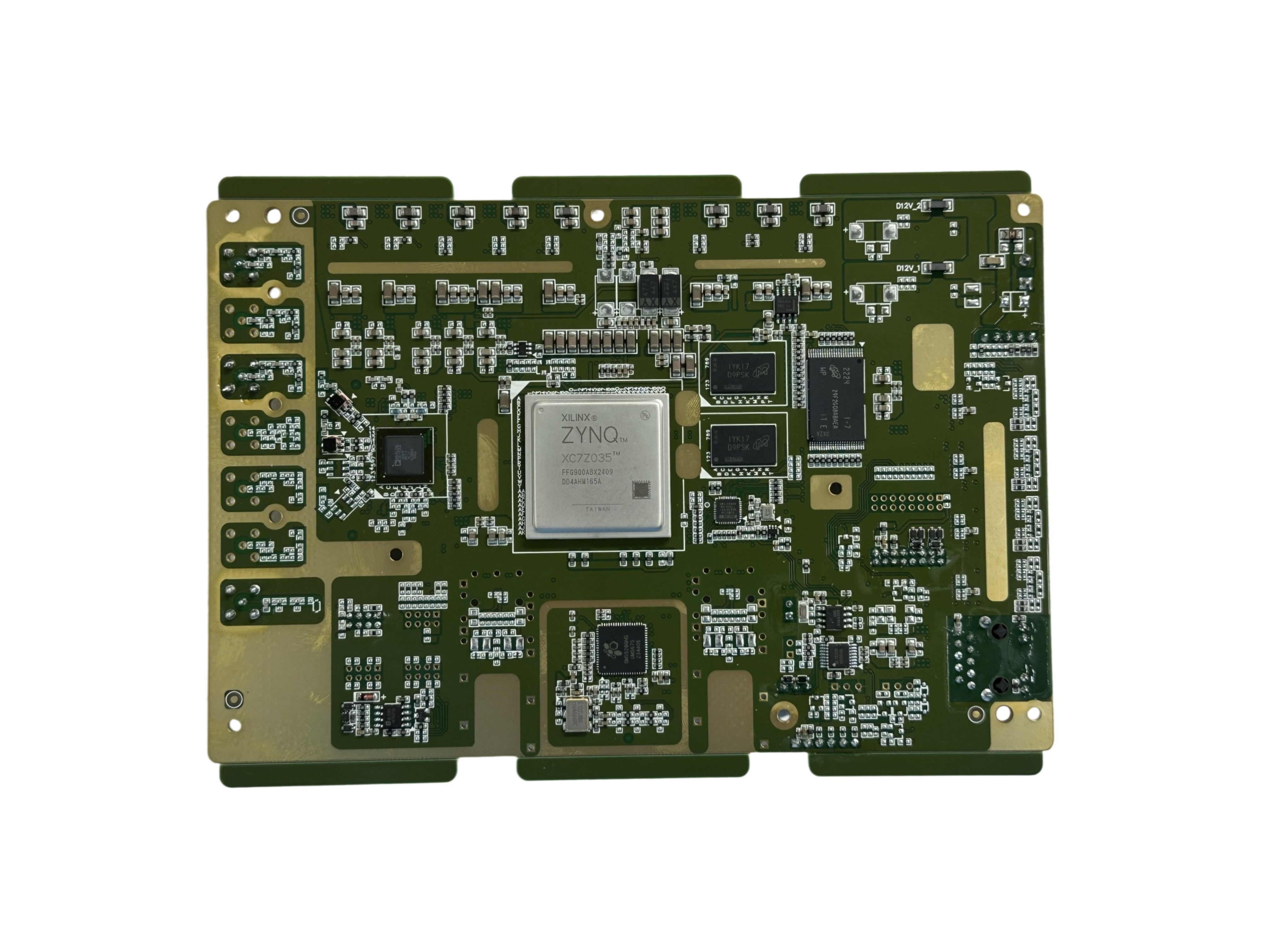
A board rarely dies because the circuit was wrong; it dies because the enclosure made a small stress permanent. Mounting holes placed too close to the board edge let screw torque tear through the surrounding copper, and oversize hole tolerances allow the case to pull the PCB into a slight bow until a solder joint cracks. Giving each fastener a clear landing area and keeping the plated hole wall well back from any grounded copper does more for longevity than adding another layer of fiberglass.
Air movement inside a small sealed shell is easy to overrate. Most heat leaves through conduction and radiation, so a thermal pad between the hottest component and the metal lid or a screw post that drains heat into the base tends to beat a few decorative vents. The detail that matters is not the instant temperature reading but the junction temperature at full load after an hour, then again after a thousand thermal cycles. Repeated expansion and contraction is what peels solder away from pads, especially under large ceramic parts.
Connectors and wiring harnesses are the next quiet killer. If the insertion force lands directly on the solder legs, a few service visits are enough to lift a pad; if a loose cable bundle resonates during shipping, it acts as a lever on the terminal. Mount external jacks to the shell with screws or snap features and let the board carry only signals, not mechanical load. Against humidity and salt mist, the weakest point is usually not the gasket but the edge coverage of conformal coating, where a thin or broken line lets condensation creep under a component instead of stopping at the mask.
Why Identical Gerber Files Still Yield Different Field Results
Two boards fabricated from the same Gerber set can end up with measurable differences because the files describe geometry, not the physical realities of laminate, copper, and processing. Dielectric constants vary from batch to batch, copper foil roughness changes the effective permittivity, and etch undercut shifts trace widths by a few microns. Those microscopic deviations alter impedance, propagation delay, and crosstalk in ways that no CAM file records.
Stackup tolerances matter just as much as trace geometry. Press-out thickness, prepreg resin flow, and final oxide treatment all influence field distribution between layers. When a simulator treats every layer as a perfect planar sheet with nominal material values, it misses the local glass weave pattern and resin-rich areas that affect high-speed signals. A different panel, a different day, or even a different region on the same panel can produce field results that look like a design change without a single edit to the Gerber data.
Reflow Habits That Separate Repeat-Order Shops from One-Time Suppliers
Repeat-order shops treat every completed sale as the start of a measurement loop rather than a finished transaction. They pay attention to which customers drift away, how long the gap lasts, and what triggers a second purchase. That information gets folded back into order follow-up, restock timing, and even the way they phrase a routine check-in. One-time suppliers rarely look past the invoice, so they miss the small friction points that quietly convince a buyer to try someone else next time.
A more practical habit is designing the next order as a low-effort repeat instead of a brand-new decision. These shops remember preferred specifications, keep past order details easy to retrieve, and send reorder reminders before inventory pressure becomes urgent. The message feels closer to a confirmation than a sales pitch. Suppliers that only react to incoming requests end up competing on convenience after the customer has already started looking elsewhere.
There is also a noticeable difference in how they handle expectations. Repeat-order shops tend to understate delivery speed or product performance slightly, then leave small room to exceed those promises in ways the customer can see. That gap between expectation and result builds a quiet reason to return. One-time suppliers often do the opposite: they promise aggressively to secure the first order, but the letdown that follows makes the next purchase feel like a risk the buyer would rather avoid.
Managing Last-Minute Substitutions Without Quietly Lowering the Standard
The real test of a team isn't the plan that survives contact with the schedule; it's how the group absorbs a sudden absence without pretending the change doesn't matter. When someone steps into an unfamiliar role at the last minute, the instinct is often to trim the edges: shorten the setlist, skip the third act, approve the safer draft, settle for a version of the event that simply ends without falling apart. That quiet lowering of the bar rarely shows up as an explicit decision. It appears as a collective exhale, a shared relief that things still happened, even if they happened smaller. The problem is that the people in the room can usually feel the difference between a substitution that protected the standard and one that quietly redefined it.
A better approach treats the last-minute change as a narrowing of options, not a narrowing of ambition. The goal stays fixed. The pathway to it gets shorter. That means before anyone rehearses a line or reviews a chart, the person coordinating the replacement names the few things that cannot be sacrificed: the arc of the program, the clarity of the core message, the emotional peak the audience came to experience. Everything else becomes negotiable. This creates a strange kind of freedom. The substitute isn't asked to replicate the original person's every move, only to preserve the experience the audience was promised. When that distinction is made early, the team can cut material, adjust timing, and redistribute responsibilities without gradually accepting a weaker result.
The hardest part is resisting the polite fictions that make a lowered standard feel acceptable. Phrases like “nobody will notice” or “it still works” often signal the moment when the team has started grading itself on effort rather than effect. Holding the line doesn't mean pretending a last-minute substitution is ideal. It means saying plainly what changed, what was done about it, and what the audience should still be able to count on. That honesty makes the adjustment more disciplined. It also gives the replacement a clearer target, because the goal isn't to avoid embarrassment; it's to deliver the same essential outcome through a different person. When the standard remains visible, it becomes easier to see whether the substitution actually succeeded.
Keeping High-Volume Lines Steady When Labor and Component Supply Shift
High-volume assembly rarely sees labor and component availability move in sync. When a line depends on a fixed crew and a single approved reel of parts, one absence or one late shipment is enough to break cadence. A steadier setup treats changeover and replenishment as conditions that will shift, not as exceptions. That means qualifying alternate passives or connectors before they are needed, and laying out stations so a newly trained operator can reach standard pace within a shift or two.
Cross-training only helps if it keeps up with turnover. Short weekly rotations on the two or three stations that bottleneck output tend to work better than occasional classroom sessions. Tie those skills to shift preferences or a small pay differential and people actually maintain them. On the supply side, keep a short list of pre-approved second sources for the parts that stop a line, not just the expensive ones. A buyer should be able to pull from that list without calling engineering every time.
Some buffer belongs inside the process, not only in the warehouse. Pre-built subassemblies or a deliberate queue before a flexible cell give supervisors room to reassign people when someone calls in sick or a feed is short. Letting line leads adjust pace on low-risk operations usually beats waiting for a planner to reschedule. The goal is not to eliminate swings, but to keep them from turning into missed shipments.
FAQ
Pad geometry tends to get ignored because the prototype worked, but at volume the solder paste deposit shifts enough to create opens on fine-pitch parts. Another one is missing fiducials near panel corners, which slows optical alignment and adds placement drift. Also, if the design has thermal reliefs that are too aggressive on high-current planes, you get voiding and tombstoning on small passives during reflow.
Ask for a recent first-article report with actual measured values, not just pass/fail stamps. Request solder paste inspection data for a few consecutive runs and look for process capability numbers like Cpk on paste height and volume. A strong shop will also share reflow profile data tied to your specific board's thermocouple placement. If they hesitate on that level of detail, treat it as a flag.
ENIG generally holds up better than OSP if there's any shelf-life uncertainty, because OSP degrades once the protective film is disturbed and can lead to wetting failures. But if your volume supports just-in-time assembly and the boards are handled carefully, OSP is cheaper. For press-fit connectors or edge contacts, hard gold is still the safest choice despite the cost.
Shrinking component pitches and denser layouts have made manual inspection unreliable for catching lifted leads or micro-solder balls. Automated systems now combine angled cameras with height measurement so they can flag heel cracks and insufficient solder that a top-down view misses. The better factories treat inspection data as feedback for placement and paste printing, not just a final gate.
Turnkey becomes attractive when your bill of materials has many common passives and standard ICs, because the assembler can pool purchasing across customers and often gets better pricing or allocation. Consigned parts still make sense for custom silicon, long-lead connectors, or safety-critical components where you need strict traceability to a specific lot.
You often need a longer soak zone to bring large copper planes and thick traces up to temperature evenly, otherwise you get cold joints near big ground pours. Peak temperatures also sit in a narrower window, so the profile has to be tuned board-by-board. If the assembler runs a generic SAC305 profile, boards with heavy copper will show more voiding and inconsistent intermetallic formation.
At minimum, you want the solder paste lot and expiry, the reflow oven profile used for that batch, and placement machine records showing nozzle and feeder positions. For higher-risk electronics, add component date codes tied to board serial numbers and x-ray images for BGAs or QFNs. That level of data makes field failure analysis much faster.
Electrical test catches opens and shorts, but it won't reveal marginal solder joints, micro-cracks under BGAs, or contamination left under low-standoff parts. Vibration, thermal cycling, and humidity expose those weaknesses later. Residual flux can also create leakage paths on high-impedance nodes even when initial test readings look clean.
Conclusion
A lot of what determines reliability happens before the first solder paste print. Walking a Chinese assembly floor, you quickly notice whether stencils are cleaned at the right interval, whether boards are handled by edges, and whether operators recheck the first article after every material lot change. Those small habits matter more than the quoted equipment list. The same Gerber data can produce different field outcomes because surface finish, laminate quality, and the exact reflow window are rarely locked in the data package. When a design pushes components close to a mounting hole or leaves a tall capacitor near an enclosure rib, the board may pass electrical test on the bench and still crack or short after installation. Designers who treat the mechanical environment as part of the electrical design usually get a more forgiving build.
Reflow habits separate shops that chase repeat orders from those that ship once. A good supplier will adjust the profile for board thickness, copper mass, and the thermal load of large BGAs rather than running a generic curve. When a resistor or connector suddenly goes out of stock, the reliable factory verifies the substitute’s solder wetting, package height, and derating instead of quietly swapping it in. High-volume lines stay steady because they plan for labor turnover and component allocation shifts with clear documentation, in-process inspection points, and a running log of every change. That discipline keeps a busy week from turning into a batch of field returns.
Contact Us
Contact Person: Zhi Zhou
Email: [email protected]
Tel/WhatsApp: 8618319494339
Website: https://www.sajznpcba.com/