

Dry Type Transformer Suppliers in China You Can Rely On
2026-11-02
Choosing the right dry type transformer supplier in China can make or break your project’s reliability and long-term performance. With countless options flooding the market, it’s easy to feel overwhelmed. That’s where Wenma stands apart—a name trusted by engineers and procurement teams for consistent quality, safety, and responsive support. In this post, we’ll walk you through what truly matters when evaluating suppliers, and why Wenma deserves a spot on your shortlist.
What Consistent Quality Looks Like in a Dry Type Transformer Supplier
Consistent quality in a dry type transformer supplier rarely announces itself through a single flawless test report. It shows up in the small, unglamorous details: the same core loss figures across batches made months apart, the same low partial discharge readings on units pulled at random from the floor, and the same measured impedance values that stay inside a band tighter than the standard demands. A supplier that takes this seriously will regulate resin viscosity and gel time during the vacuum casting process, control winding tension to avoid strand movement, and verify the thickness of the insulation on every coil rather than relying on spot checks. When those parameters are held steady, the end product stops being a collection of individually proven parts and starts behaving like one repeatable design.
Another place consistency becomes visible is in how the supplier handles incoming materials and in-process drift. Electrical steel from the same mill can still vary from heat to heat, so the best operations test core loss at receiving and adjust processing to keep no-load performance stable. Copper conductor purity, resin batch reactivity, and even the moisture content of insulation layers are checked before they can affect a unit. During production, curing profiles are logged against each coil serial number, and any small drift in temperature or vacuum level triggers an immediate correction rather than a note for the next batch. That discipline shows up later as fewer hot spots, lower noise variation, and a longer average service life across the installed fleet.
Finally, consistent quality leaves a paper trail that is useful long after the order is delivered. Instead of pass-or-fail summaries, you get actual measured values for each unit: partial discharge in picocoulombs, winding resistance, noise in decibels, and temperature rise figures from a representative sample of the production run. When two identical transformers built six months apart show nearly identical test results, you are not looking at luck. You are looking at a supplier that has removed guesswork from its own process and can explain exactly why that second unit will perform like the first.
The Production Regions in China That Actually Specialise in Dry Type Units
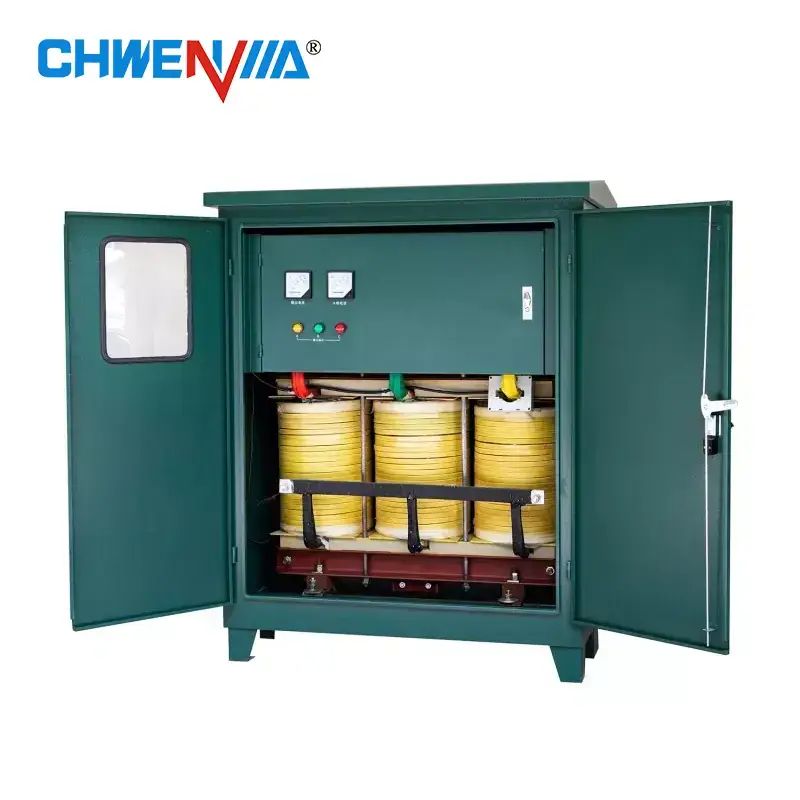
Not every industrial province in China turns out dry type units at the same depth. The real specialisation sits in the eastern coastal belt, with Jiangsu, Zhejiang and Shanghai forming the core. Suzhou, Wuxi and Changzhou in Jiangsu host a dense network of casting resin suppliers, foil winding workshops and insulation processors. Many of these factories grew out of subcontracting for older state-owned transformer plants before shifting to direct exports.
Outside the Yangtze Delta, Guangdong and Fujian handle smaller kVA ratings and custom enclosures, while Shandong and Hebei lean toward larger distribution units for northern grid projects. A less obvious factor is the role of component towns such as Liushi in Zhejiang, which feed final assembly lines across the region. This clustering cuts production cost and lead time, though quality can differ sharply from one workshop to the next—checking the actual line, not just the registered address, matters.
Questions That Reveal More Than Any Supplier Brochure
Real insight comes from asking the supplier to walk you through a recent production hiccup and how they fixed it. If the answer sounds rehearsed, keep digging. You want the messy details—the missed deadline, the material batch that failed inspection, the last-minute call to a backup logistics partner. A supplier who can name the exact root cause and the concrete change they made is worth more than any glossy PDF.
Ask them what they would never promise a customer, even under pressure. The best partners will tell you about the lead time they refuse to compress, or the quality threshold they won't lower to hit a discount. That boundary is proof they understand their own process. Then flip it: ask what they've stopped doing in the last two years. A factory that has deliberately cut a product line, dropped a raw material source, or retired an outdated machine is one that actually learns.
Finally, get them to talk about a customer they lost. Not the polite version—the real reason it fell apart. Whether it was pricing, communication gaps, or a spec mismatch, how they describe that loss tells you more about their self-awareness than any client testimonial. A supplier who blames the customer entirely is a red flag. One who can pinpoint their own contribution to the failure is someone you can build a long-term relationship with.
Why Winding and Insulation Details Deserve a Closer Look
Most winding and insulation choices are treated as routine, but the smaller decisions around layer placement, tape overlap, and varnish coverage often determine whether a machine runs cool or develops hot spots that quietly age the insulation.
The interfaces between copper, paper, resin, and lead exits are rarely uniform in practice. Small gaps or uneven impregnation can become starting points for partial discharge, especially under voltage spikes from variable speed drives. These are not dramatic failures at first—they show up as gradual loss of dielectric strength long before a short circuit occurs.
Taking a closer look at these details during design review or prototyping usually reveals adjustments that cost almost nothing but prevent a large share of field issues. A slight change in bend radius, a more controlled curing profile, or a better lead support can extend service life more than many costly upgrades.
How to Verify Test Reports Without Taking Them at Face Value
Test reports arrive with an air of finality, but smart teams treat them as hypotheses rather than verdicts. The first move is to trace every number back to its raw source—request logs, build artifacts, or test-run transcripts. Often you'll find that a passing percentage was calculated after excluding flaky cases, or that a latency figure was measured on a machine no one else uses. Pull the original data yourself, even if it's messy, and compare it against the summary. Discrepancies there tell you more than any conclusion paragraph ever could.
Next, interrogate the conditions under which the tests actually ran. A green suite at 3 a.m. on an empty staging environment says little about production traffic patterns. Ask whether the report includes retries that silently cured intermittent failures, whether timeouts were extended mid-run, or whether certain assertions were disabled due to known issues. If the test configuration isn't version-controlled alongside the code, treat the entire report as unverified folklore. Reproduce a small but representative subset of the tests in your own environment—not to re-run the entire pipeline, but to see if the baseline assumptions hold when the stars aren't perfectly aligned.
Finally, separate signal from ceremony by looking for what the report doesn't say. Did it mention the tests that were skipped because a dependency was down? The ones that only run on a schedule nobody monitors? A healthy verification process leaves breadcrumbs you can follow: commit hashes, environment snapshots, exact command-line invocations. If those are missing, or if the report reads like a press release with adjectives instead of timestamps, push back. Verification isn't about believing harder—it's about making the evidence walk on its own two feet.
The After-Sales Signals That Separate Long-Term Partners From One-Off Sellers
Real partnership rarely shows up at the signing table. It appears a week after delivery, when the vendor checks whether the product actually solved the problem you bought it for. One-off sellers send an invoice and disappear; long-term partners ask what broke, what surprised you, and what you'd change next time. That follow-up call—not the sales pitch—tells you who expects to see you again.
Another signal lives in how complaints are handled. A transactional supplier treats a defect as your problem to prove. A partner treats it as their problem to own, often shipping a replacement or dispatching a technician before you finish describing the issue. They don't hide behind warranty fine print, because the relationship matters more than the margin on one order.
Then there's the quieter stuff: software patches that arrive without being requested, spare parts that show up before you realize you need them, or a brief note about a compatibility issue discovered in another client's setup. These aren't profit-seeking gestures. They're maintenance behaviors that reveal whether a seller is building a customer list or a network of collaborators.
FAQ
Dependable suppliers share a few non-negotiable traits: they openly share full test reports, use grade-A copper or aluminum windings rather than recycled materials, and have engineers who ask about your load profile before quoting. You can usually spot this within the first two emails.
Ask for a live video walkthrough of the winding and core cutting areas, and compare the factory address on their business license with the one shown on camera. A real manufacturer will also have in-house vacuum pressure impregnation tanks and a dedicated test bay, not just a final assembly bench.
At minimum, look for IEC 60076-11 compliance and a recent type test report from an independent lab like KEMA or ASTA. For export to North America, UL listing or CSA certification matters; for the Gulf region, SASO or equivalent approval helps cut customs delays.
They remove the risk of oil leaks and fire suppression costs, which is why hospitals and data centers lean toward them. They also handle occasional overloads without degrading insulation as quickly, and maintenance usually stops at visual inspection and occasional cleaning of ventilation ducts.
Specify the exact grade and thickness of silicon steel, the type of insulation class, and whether windings are copper or aluminum foil. Then ask for material certificates from the steel mill and a signed penalty clause if a third-party inspection finds substitutions.
Yes, most established factories build to order rather than from stock. You can request non-standard impedances, neutral earthing arrangements, special temperature rise limits, or marine-grade enclosures, and they will adjust the design within a few days.
For standard ratings up to about 2,500 kVA, expect 20 to 35 days after drawing approval. High-voltage units or those with special enclosures can take 45 to 60 days, and shipping to Europe or the Americas adds another three to five weeks.
They typically provide remote diagnostic guidance first, then ship spare parts or send an engineer if the problem persists. The better ones keep winding records for each serial number, so they can tell you exactly which core lot and insulation batch was used years later.
Conclusion
For a dry type transformer supplier in China, consistent quality shows up in how they handle core lamination, resin casting, and final testing on every batch, not just samples. The delta around Shanghai, Ningbo, and Suzhou has become a cluster for dry type units because suppliers there can source qualified copper wire, epoxy resin, and insulation materials quickly, and many factories invest in vacuum casting lines rather than relying on atmospheric pouring. Asking pointed questions about which casting method they use, what temperature controls they keep on the resin, and how they track batch numbers will reveal far more than any polished catalogue.
Winding and insulation details separate dependable partners. Look at whether conductors are wound evenly with proper tension, whether layer insulation is Nomex or polyester film, and whether the resin penetrates fully without voids. When a test report arrives, verify it by requesting the serial number on the unit, the date of the test, and the raw data from the partial discharge measurement; many credible suppliers will let you witness a repeat test. After-sales signals matter too: a long-term partner will ask about installation conditions, keep winding diagrams on file, and respond to field questions without first demanding a purchase order. Those habits signal a supplier that expects to stand behind the unit for years.
Contact Us
Contact Person: Mr. Jiang
Email: [email protected]
Tel/WhatsApp: +86-15057775503
Website: https://www.avrfactory.com/