

Dual Fuel Generator Factory Innovations Powering Reliable Energy Solutions
2026-08-15
A factory floor isn’t the first place most people look for energy breakthroughs — yet that’s exactly where DINGBO POWER is turning dual fuel generator production into a source of reliable, cost-smart power. From smarter fuel switching to load-tested designs that shrug off unstable grids, the innovations coming off these lines are changing how businesses think about backup and prime power. Here’s what’s driving that shift.
The Factory Secret Behind Generators That Switch Fuels Mid-Load
On the assembly floor, the real trick behind mid-load fuel switching isn't hidden in a software update. It's in how the fuel rails are torqued and the exact sequence used to bleed air from the dual-feed lines. A generator that can swap from diesel to natural gas while under full electrical load needs a pressure balance most engineers overlook: the slight flex in the intake manifold must be compensated by a spring-loaded diaphragm valve positioned just after the throttle body. Without that factory-specific preload, the flame front stumbles and the engine hunts for a steady RPM.
The secret gets more interesting inside the cylinder head. Instead of drilling separate injector ports for each fuel type, the assembly team installs a coaxial needle that seats against a hardened insert with a tolerance window of just twelve microns. Too tight, and the gaseous fuel can't atomize properly when the liquid fuel is cut off. Too loose, and you get dribble that cokes the tip within the first fifty hours of dual-mode operation. Every unit leaving the line gets a cold-flow test with dyed fuel to confirm the spray pattern stays within a three-degree cone during the switchover, a check that most aftermarket tuners skip entirely.
Perhaps the least documented factory adjustment is the mass-damper weight hidden inside the governor linkage. During a fuel swap, the rotational inertia of the crankshaft changes slightly because the two fuels burn at different rates. To keep the governor from overcorrecting and surging the output, technicians add a small tungsten slug to the linkage arm—about four grams for a 200 kW unit. It sounds trivial, but that tiny mass shifts the resonant frequency just enough to let the generator ride through the transition without tripping a single protective relay. It's the kind of detail that only appears after thousands of hours of dyno testing and a few warranty claims that forced the design team back to the drawing board.
Why Your Next Backup Power Unit Might Arrive Pre-Tested for Both Fuels
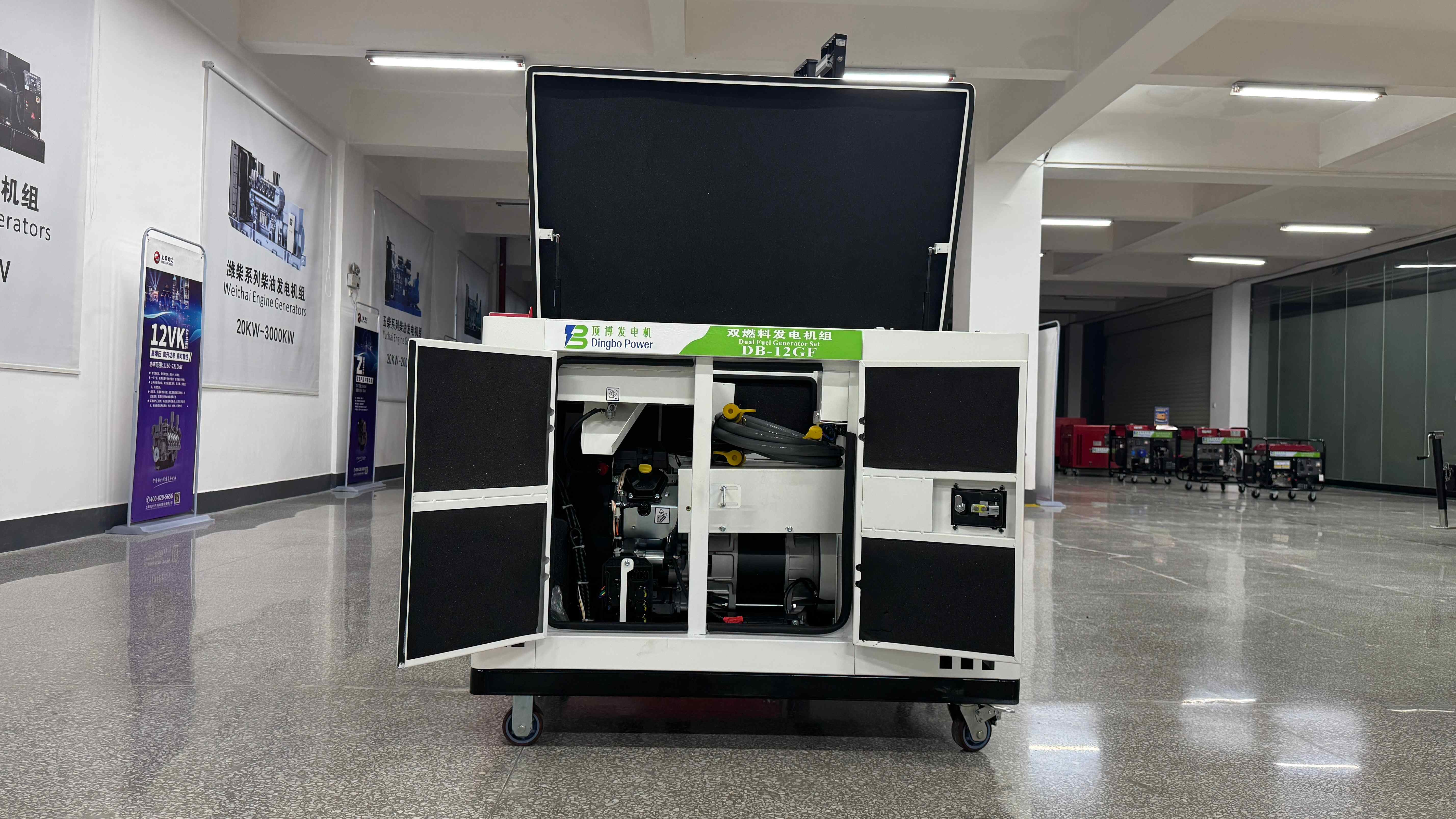
Factory pre-testing for both fuels used to be reserved for large industrial generators. That is changing as more backup units ship with dual-fuel capability. When a manufacturer runs a set through its full start sequence on diesel and then on natural gas before crating, issues like incorrect fuel pressure settings, injector mapping gaps, or lazy transfer switches show up at the plant rather than on your loading dock.
The practical upside is shorter commissioning. A unit that has already proven it can hold voltage and frequency while switching fuels needs less onsite tuning. It also gives you a baseline: if something drifts after installation, you know the equipment was healthy when it left the factory. That matters when the outage hits and you do not want to discover a fuel map problem at 2 a.m.
Fuel availability is another driver. A unit that arrives tested on both fuels can be deployed where supply is uncertain. If natural gas service stops, the generator can fall back to diesel without a field modification. Previously that flexibility required onsite technicians and hours of verification. Now the proof is in the crate.
Inside the Calibration Rooms Where Dual Fuel Reliability Gets Baked In
The calibration rooms smell faintly of hot metal and ozone. Rows of dual fuel engines sit bolted to test beds, each one wired to a bank of sensors that track injection timing, exhaust temperature, and combustion stability under ever-shifting gas-to-diesel ratios. Engineers here don't trust datasheets; they trust what happens when a unit is pushed past its nominal curve and held there for hours while the room's climate control mimics a desert noon or an Arctic night.
A typical session starts with a cold soak to settle the block and fuel rails, then moves into step-load cycles that alternate between 100% natural gas and heavy diesel backup within milliseconds. The real work happens in the transition zones, where a misfire or a lag spike can shorten a component's life by half. Technicians watch thermal cameras and acoustic sensors, listening for the dull knock that signals an injector drifting out of spec.
Every calibration recipe gets versioned and revisited after field data returns from remote sites. What gets baked in here isn't just a map of fuel trims, but a margin of error that survives dust, bad fuel batches, and operators who ignore the manual. The rooms run around the clock, because reliability isn't a label; it's a number that has to hold.
What Happens When the Gas Line Drops Pressure at 3 a.m.
At 3 a.m. the house settles into that deep, brittle quiet. Then the boiler's blue flame hiccups, the radiators stop ticking, and the warmth leaches out of the pipes faster than you'd think. You wake up because your feet are freezing under the duvet, and the first thing you notice is the silence where the burner's hum should be.
Downstairs, the gas cooktop won't even spark a proper ring of fire—just a weak, sputtering halo that dies the second you let go of the knob. The water heater delivers a shock of icy water if you're brave enough to test the tap. Every appliance that runs on gas is suddenly running on nothing, and the house starts to smell like cold metal and damp air.
Most of the time it's not a leak but a supply dip from the utility side, or a frozen regulator outside the meter. You'll stand there in the dark with a flashlight, shivering in your socks, listening for a hiss that isn't there. The utility's emergency line puts you on hold, and somewhere down the street the same thing is happening to a dozen other houses, all of them waking up to a cold stove and a colder shower.
The Emissions Trade-Off Dual Fuel Engineers No Longer Accept
For years, dual fuel engines were sold on a simple promise: cut carbon dioxide and accept a little extra methane slip or higher NOx as the price. That bargain is collapsing. Engineers who once nodded along to emissions trade-offs now see them as a design failure, not a compromise. The shift is visible in new engine rooms where real-time methane sensors and closed-loop combustion controls are no longer optional add-ons but standard equipment.
The old logic treated emissions like a zero-sum game—lower CO2, raise something else. But tighter IMO Tier III and EU Stage V rules, along with operators facing methane penalties, have rewritten the math. A dual fuel engine that reduces CO2 by 20% but vents unburned methane is now seen as a liability. Marine and power generation teams are pushing for aftertreatment systems that scrub both NOx and particulate matter while also re-burning crankcase gases that used to escape.
What engineers no longer accept is the idea that a clean engine can have a dirty corner. They're redesigning injectors, piston bowl geometries, and valve timings to cut methane slip below 0.2 g/kWh, a threshold that was laughable a decade ago. The result is a new class of dual fuel engines that treats every emission stream as an engineering target to eliminate, not a trade-off to manage.
Six Questions That Separate a Real Dual Fuel Workhorse from a Compliance Label
Spec sheets have a way of smoothing over the exact spots where dual fuel systems fall apart. Run a unit on natural gas for three days, then switch to propane under a heavy cold load, and you will quickly see whether the fuel mapping was engineered or merely patched. A real workhorse holds its exhaust temperature and throttle response through the transition; a compliance label stumbles, throws a soft code, or defaults to a limp mode that nobody mentions in the brochure.
The second question is whether the fuel solenoids and pressure regulators are sized for continuous duty on both sides. Many dual fuel generators use the secondary fuel path as an afterthought—narrow passages, fixed orifices, no active trim. When inlet pressure sags at the end of a municipal gas line, the unit either hunts or shuts down. A purpose-built platform adjusts air-fuel ratio on the fly, even when both fuels are available at once, and does not treat the secondary fuel as a backup alarm.
Then dig into the maintenance intervals and the parts list. If the service schedule doubles injector cleanings on propane but not on natural gas, or if the warranty quietly excludes long-run secondary fuel use, that is a label doing compliance math. The true dual fuel workhorse shares duty ratings across every component in the fuel train, so the only question left is how many hours you can log before the first oil change.
FAQ
The engine is fitted with a gas mixing system that lets it run on a blend of diesel and natural gas or biogas. Diesel still initiates combustion, but the gas portion can cover a large share of the load, cutting fuel costs and extending runtime between refueling stops.
Every set goes through a staged load bank test, usually in 25% increments up to 110% of rated output. The control panel logs voltage, frequency, oil pressure, and exhaust temperature, and only units that stay within tolerance across all steps are cleared for crating.
Yes. The controller monitors gas supply pressure and engine load in real time. If gas pressure drops or a sensor flags a fault, it trims the gas valve and ramps diesel delivery smoothly, so the transfer happens without a voltage dip or shutdown.
Mining camps, agricultural processing plants, and isolated telecom towers are strong candidates. They often have access to low-cost gas or biogas on site, and the dual fuel setup lets them keep diesel as a backup while using the cheaper fuel for day-to-day running.
The controller starts the engine on diesel only, then phases in gas once coolant temperature and load conditions are stable. This protects the engine from knocking and ensures reliable ignition even when gas quality fluctuates.
Depending on gas availability and engine load, the diesel displacement can range from 40% to 70%. High, steady loads tend to produce the best substitution rates, while light or highly variable loads may see lower savings.
Oil change intervals can sometimes stretch slightly because gas combustion produces less soot, but spark plugs, gas valves, and filtration need more frequent inspection. A 250-hour check on gas line seals and regulator diaphragms is a practical habit.
Yes. The factory can supply trailer-mounted units, weatherproof enclosures, remote monitoring packages, and gas train components sized for specific fuel compositions, all tested as a complete assembly before dispatch.
Conclusion
At the core of today's dual fuel generator production is a calibration process that no longer treats gas and diesel as separate afterthoughts. Factories run every unit through load-bank trials where the engine switches from 100% diesel to high natural gas substitution under full electrical load, not in a staged demo. The secret isn't a magic injector; it's a control loop tuned in soundproofed cells so the governor, fuel valves, and knock sensors react within milliseconds. That same room bakes in the answer to the 3 a.m. pressure-drop scenario: instead of tripping offline, the unit should ride through a sagging gas line by trimming diesel delivery without a hiccup. If it can't, it gets pulled and re-tuned before it ever gets a serial plate.
Pre-testing for both fuels has moved from a customer option to a factory default. Every backup unit ships with a log showing full-rated output on diesel, full-rated output on natural gas, and a blended step test at 50%, 75%, and 100% load. This kills the old compliance-label trick where a generator carried a dual fuel badge but was only validated on diesel. Engineers now reject the notion that lower emissions must come with unstable combustion; they chase a narrow window where NOx drops but cylinder pressure remains smooth. Buyers should ask six things: what substitution rate holds at full load, how fast the transfer happens mid-load, what happens during gas pressure sag, whether the calibration log matches the serial number, how cold starts behave on gas, and whether the emissions map was developed in-house or borrowed. The answers separate a real dual fuel workhorse from a sticker.
Contact Us
Contact Person: Rita
Email: [email protected]
Tel/WhatsApp: +8613481024441
Website: https://www.dbdieselgenerator.com/