

Laser Safety Curtain Factory Insights: Choosing the Right Protective Solutions
2026-06-10
Industrial laser systems demand more than just performance—they require uncompromising safety. Yet, navigating the world of laser safety curtains can be daunting, with countless options that often blur the line between adequate and exceptional protection. This is where LASERPAIR redefines the standard, offering factory insights that cut through the noise. In this blog, we explore what truly matters when selecting protective solutions, from material resilience to custom engineering, ensuring your workspace stays both productive and secure.
Material Integrity: The Core of Laser Curtain Performance
When you pull back the curtain on what makes a laser curtain truly effective, it’s not the beam itself that steals the show—it’s the material. Every fold, every fiber carries the weight of blocking, diffusing, or directing light, which means even the smallest compromise in material choice can ripple outward into inconsistent coverage or premature failure. We’ve seen setups where a minor tear turned a precision safety zone into a blind spot, all because the fabric wasn’t rated for repeated flexing or the splicing method introduced a weak point invisible to the naked eye. The lesson is blunt: performance lives and dies by the physical integrity of the barrier, not just its electronic specs.
That integrity unfolds on multiple levels, from macroscopic durability down to the polymer chains that resist photodegradation. For instance, a curtain meant to contain UV or near-infrared wavelengths can’t simply rely on surface coatings; the base material itself must be inherently stable against the photon energy it encounters daily. Add in environmental wildcards—humidity swings, airborne particulates, thermal cycling—and you’re asking the material to juggle contradictions: remain pliable enough to install without micro-cracking, yet stubbornly opaque to the target spectrum. When manufacturers cut corners with cheaper substrates that bleach or become brittle after months of exposure, the entire safety logic unravels, because a curtain that stops behaving like a curtain stops being a safeguard.
Beyond the raw stock, the way a curtain is assembled can prop up or undermine its core integrity. Seams, hems, and anchoring points become the test beds for long-term reliability, often failing before the main panels, so welding or bonding techniques that preserve molecular continuity matter just as much as the material grade stamped on a datasheet. One understated truth is that a well-engineered curtain quietly outperforms its paper specifications—not through magic, but through an unglamorous discipline of matching material behavior to real-world stress vectors, ensuring that what holds in the lab holds even better in the field.
Tailored Protection: Custom Sizing for Unique Factory Layouts
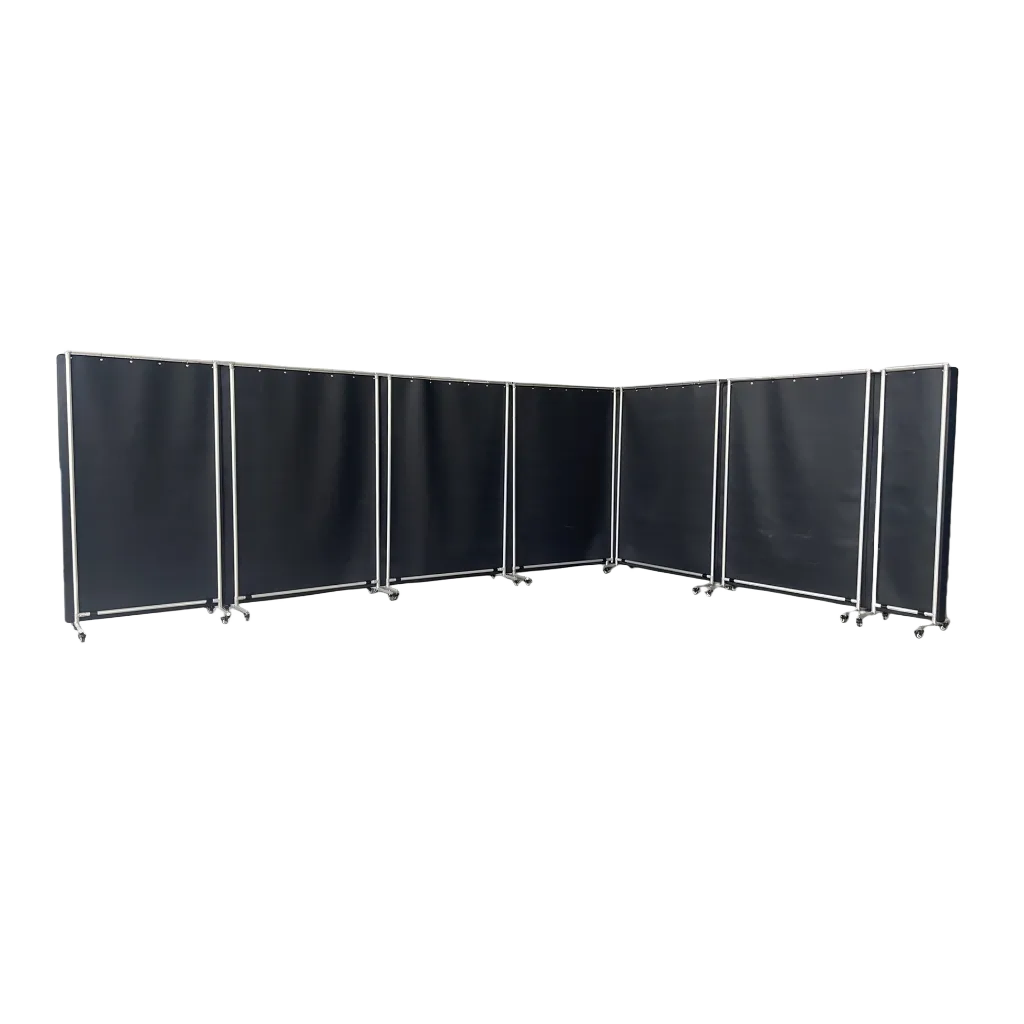
Every factory floor tells a different story. Uneven columns, oddly placed machinery, and tight corridors don’t have to be obstacles—they just need a smarter approach to protection. Our custom sizing adapts around your layout, wrapping pillars, guarding rails, and shielding equipment exactly where it’s needed, not where it’s convenient for a manufacturer to cut.
The process starts with precise measurements, often using digital scans to capture every irregular corner. We engineer each section to fit like a glove, maximizing impact protection without wasting an inch of valuable workspace. The result is a safety shield that blends into the flow of your operations rather than disrupting it.
Durable polyurethane and steel composites form the backbone of these tailored solutions. They absorb repeated impacts from forklifts and heavy carts without losing shape or requiring frequent replacement. Unlike generic barriers, these custom-fitted guards maintain clean lines and unrestricted movement paths, keeping your factory both safe and efficient for years.
Certification Essentials: Meeting ANSI and IEC Standards
Navigating the certification process for ANSI and IEC standards requires a clear grasp of their distinct yet complementary roles. ANSI (American National Standards Institute) focuses on harmonizing U.S. industry practices, ensuring product safety and interoperability within North American markets. In contrast, IEC (International Electrotechnical Commission) standards pave the way for global market access, especially in Europe, Asia, and beyond. Manufacturers often face the challenge of aligning their designs with both frameworks, as overlapping but non-identical requirements demand meticulous attention to test protocols, documentation, and labeling. A practical approach involves mapping out common ground early—such as insulation requirements or electromagnetic compatibility—and then layering the specific expectations of each standard to avoid redundant testing cycles.
One of the trickiest aspects lies in understanding how deviations between ANSI and IEC methodologies impact product evaluation. For instance, ANSI standards for electrical equipment might prioritize field-wiring practices common in North America, while IEC equivalents emphasize international voltage tolerances and environmental conditions. This means that a device designed from the ground up to meet IEC 60601 for medical electrical equipment may still need supplementary testing for ANSI/AAMI ES60601-1 if U.S. market entry is a goal. Skilled engineering teams often integrate both sets of criteria into early design reviews, using gap analyses to preempt compliance bottlenecks. That way, when the time comes for third-party testing at an accredited lab, the product already addresses the most stringent requirements, smoothing the path to dual certification without costly last-minute redesigns.
Documentation is the unseen backbone of certification success. Both ANSI and IEC regimes expect robust technical files that trace every design decision, risk assessment, and test result. Instead of treating paperwork as an afterthought, forward-thinking companies adopt a modular documentation structure that mirrors the clauses of the relevant standards. This not only speeds up auditor reviews but also simplifies updates when standards evolve—as they frequently do. Regularly checking for amendments and maintaining open communication with certification bodies can prevent surprises. Ultimately, meeting ANSI and IEC standards isn’t a one-time checkbox; it’s an ongoing discipline that, when woven into product lifecycles, becomes a reliable gateway to diverse markets.
Installation Best Practices: Ensuring Flawless Function
A methodical pre-installation check prevents nearly all post-setup headaches. Begin by verifying that every component in the shipment matches the packing list, and inspect connectors, cables, and mounting hardware for damage that might have occurred in transit. Clear the work area of dust and debris, and confirm that environmental conditions—temperature, humidity, and vibration levels—fall within the equipment’s specified tolerances. This up-front diligence eliminates the need for mid-installation troubleshooting and dramatically cuts the risk of latent failures that surface weeks later.
Mounting and alignment demand patience: rushing through these steps is the fastest route to callbacks. Use a spirit level or laser alignment tool rather than trusting your eye, and always torque fasteners to the manufacturer’s recommended values with a calibrated wrench. When routing cables, maintain minimum bend radii and keep power and signal lines separated by at least the distance specified in the manual—crosstalk and electromagnetic interference are invisible gremlins that degrade performance silently. For rack-mounted gear, evenly distribute weight and secure each device from the front and rear to avoid sagging that stresses internal solder joints.
Before you declare the job done, run a staged commissioning sequence that exercises each subsystem independently, then the integrated whole. Record baseline readings—current draw, signal-to-noise ratios, pressure readings—and compare them to factory benchmarks. Any deviation, however small, warrants investigation; today’s minor anomaly is tomorrow’s shutdown. Finally, label every cable, breaker, and access point clearly, and leave the site cleaner than you found it. Those small touches signal thoroughness and build trust that pays dividends long after the final walkthrough.
Proactive Maintenance: Extending Your Curtain's Lifespan
Proactive maintenance shifts your focus from reactive fixes to daily habits that preserve your curtains. Instead of waiting for stains to set or seams to split, you integrate small checks into your routine. For instance, gently running your hand along the header tape every few weeks can alert you to weakening threads long before they give way.
Environmental stressors like direct sun and moisture don't have to dictate your drapes' destiny. Using sheer underlayers or applying a fabric protector designed for your curtain material can deflect UV rays and repel light spills. In rooms with high humidity, a dehumidifier works wonders, preventing mildew that silently eats away at fibers.
Don't underestimate the power of a careful clean. Instead of harsh detergents, opt for baking soda sprinkled over the surface, left overnight, then vacuumed away—it lifts odors and light soiling without water stress. For washable curtains, always use cool water and the delicate cycle, and reshape them while damp to avoid permanent creases.
Cost-Effective Safety: Maximizing ROI with Smart Choices
Many organizations mistakenly equate safety spending with buying the most expensive equipment or hiring extra personnel. In reality, smart choices—like investing in staff training to spot hazards early or using modular, reusable safety systems—often yield far better returns. By focusing on prevention rather than reaction, you avoid the hidden costs of downtime, legal fees, and reputational damage that cheap shortcuts inevitably bring.
ROI in safety isn’t just about reducing incident rates; it’s about spending where it matters most. For example, a simple upgrade to ergonomic workstations can slash repetitive strain injuries and related insurance claims without six-figure outlays. Similarly, adopting digital safety analytics to pinpoint high-risk tasks lets you target resources precisely, instead of spreading budgets thin across low-impact areas.
Finally, long-term value comes from weaving safety into everyday operations so it becomes self-sustaining. Peer-driven safety observations, cross-training employees to recognize diverse risks, and choosing versatile protective gear that workers actually use all create a culture where safety pays for itself. The result is a workplace where every dollar spent not only protects people but also strengthens the bottom line.
FAQ
Start by checking the laser's wavelength and power density—those directly dictate the optical density (OD) you need. Also look at the physical environment: will there be mechanical stress, sparks, or chemicals? That'll tell you if you need a hard-shell curtain or a flexible fabric one. And don't forget about access requirements; sometimes a combination of fixed panels and sliding curtains works best.
It's like choosing between a raincoat and an umbrella. Some materials, like laminated metal, block nearly all laser radiation but are rigid. Polycarbonate-based curtains offer clarity for visibility but might not handle high power. For versatile protection, multi-layer fabrics with embedded metallic threads can combine flexibility with high attenuation, but each layer targets specific wavelength ranges.
Longevity isn't just about the material—it's about how it's assembled. Look for reinforced seams, stainless steel grommets, and UV-resistant coatings. A curtain that frays or fades after a year of use isn't reliable. Also, factories should provide maintenance guidelines; a simple wipe-down with the right solvent can prevent degradation.
Absolutely. I've seen curtains shaped like tent enclosures for robotic welding cells, and even magnetic strips for quick medical lab setups. A good factory will ask for your layout drawings and suggest panel dimensions, track systems, or interlock integration. Customization often costs less than you'd think if you're avoiding on-site modifications later.
Shipping is the obvious one, but also think about compliance testing. Reputable factories include certification reports, but if you need extra testing for local regulations, that's extra. Then there's installation: some curtain systems need professional assembly, and if the factory doesn't provide clear instructions, you might pay more for a third-party installer.
Ask for material samples with OD test data at your exact wavelength. Also, check if they follow ISO or ANSI standards—not just claim to. A factory tour video or third-party audit report can speak volumes. I'd also recommend a pilot order: even 10 panels can reveal how they handle consistency and packaging.
Passive barriers, like most curtains, just block the beam. Active systems integrate sensors that shut off the laser if the curtain is breached. If you have high-traffic areas or mobile equipment, active interlocked curtains add a layer of fail-safety. But they're more complex and need regular function checks.
It's a niche but growing. Some factories use recycled metals in the reflective layers or solvent-free adhesives. There's also a trend toward modular designs—if a section gets damaged, you replace only that panel, not the whole curtain, which reduces waste over time. Always request a material composition sheet if sustainability is a priority.
Conclusion
Selecting the right laser safety curtain involves more than just meeting a specification sheet—it's about understanding how material integrity, precise fit, and compliance work together in your unique environment. High-performance curtains start with durable, optically dense fabrics that block harmful wavelengths without degrading under prolonged exposure. Factories benefit from custom sizing that aligns with irregular machine layouts, preventing light leaks at seams or mounting points. Equally critical is verifying third-party certifications for ANSI and IEC standards, which confirm both optical density and flame resistance. A well-fitted, certified curtain becomes a reliable barrier rather than a one-size-fits-most afterthought.
Installation excellence separates a functional system from a flawless one: proper tensioning, secure anchoring, and clear sightlines during setup prevent nuisance trips and beam misalignment. Beyond initial commissioning, proactive maintenance—like periodic cleaning with non-abrasive solutions and checking for mechanical wear—extends service life while sustaining protective performance. Smart buyers calculate total cost of ownership by weighing initial price against longevity and downtime prevention. By integrating these practical insights, facilities achieve cost-effective safety that doesn't compromise on operator protection or compliance, turning a mandatory safeguard into a long-term asset.
Contact Us
Contact Person: Jenny
Email: [email protected]
Tel/WhatsApp: +86 13537713281
Website: https://www.laserpair-safety.com/