
Lijiang Cultural Immersion: A Soulful Yunnan Journey Experience
2026-08-07
Step into a world where ancient cobblestone streets whisper tales of the Naxi people, and snow-capped mountains mirror in crystalline waters. Lijiang isn't just a destination—it's a living tapestry of culture, where every breeze carries the scent of wild herbs and every sunset paints the sky in hues of Yunnan's soul. At the heart of this enchantment lies Jade Water Village, a hidden gem where time slows and immersion becomes inevitable. Ready to trade tourist trails for true connection? Let this journey begin.
Strolling Through Time: The Ancient Labyrinth of Lijiang
Each cobbled lane in Lijiang's old town curves with quiet intention, as if it remembers the footsteps of tea traders and wandering monks. You might glance down an alley expecting a dead end, only to find a courtyard brimming with chrysanthemums and the clink of mahjong tiles. The waterways guide you just as surely as memory does, their soft murmur a companion in the search for something you didn't know you'd lost.
Buildings lean towards one another like old friends sharing secrets, their tiled roofs dark with age and damp with mountain mist. Carved wooden panels show scenes of prosperity—phoenixes and peonies—yet they carry an understated weariness, a gentle admission that silk routes fade and dynasties crumble. Here, time doesn't march; it pools in courtyards, slides over bridges, and sometimes gets tangled in the sound of an erhu drifting from an upper window.
Come evening, lanterns coax a warm, amber glow from the stone, and the labyrinth turns inward. Naxi grandmothers shuffle past, their indigo capes a slash of midnight against whitewashed walls. You realize the streets are not meant to be solved or mapped—they are meant to be inhabited, to invite you into a rhythm where wrong turns become the best discoveries and the only destination is the present moment.
Naxi Rhythms: Music and Dance of the High Plateau
In the remote reaches of northwestern Yunnan, where the mountains brush the sky, the Naxi people have cultivated a musical tradition as layered as the terrain they inhabit. Far from the polished confines of concert halls, their rhythms emerge from daily life—the pounding of grain, the shuffle of horses on cobblestone, the whisper of wind through pine forests. This is music that doesn't just accompany existence; it grows directly from it, a living archive of migration, ritual, and resilience.
Dance and melody intertwine in ceremonies that mark every threshold of Naxi life. The "Congcuo" circle dance, often performed during festivals, draws entire villages into a spiraling human chain, feet stamping ancient patterns into the earth while voices rise in call-and-response. Meanwhile, the plaintive strains of the jaw harp or the gourd flute speak a more intimate language, echoing courtship rituals and solitary shepherd's songs. These performances aren't mere entertainment—they're a form of cultural memory, encoding histories that predate written records.
What makes Naxi music truly singular, however, is its stubborn survival. Despite centuries of outside influence, key elements like the Baisha Fine Music ensemble have been preserved with almost religious devotion, played on instruments such as the sugudu and the erhuang. The ancient notation system, passed down orally and through rare manuscripts, carries modulations that mimic the plateau's own acoustics—the sudden drops, the vast silences, the echoes that seem to hang between peaks. To hear it is to step into a soundscape shaped by altitude and isolation, yet vibrantly, defiantly alive.
A Taste of Yunnan: Flavors Woven into Memory
The first breath of Yunnan is a swirl of steam rising from a bowl of Crossing-the-Bridge Noodles, the broth shimmering with a golden film of chicken fat that seals in a heat you can feel on your cheeks. It’s the crackle of wild mushrooms hitting a smoking wok, each slice releasing an earthy perfume that seems to carry the mist of the mountains where they were foraged. Here, flavor is never just taste—it’s altitude and rainfall, the patience of a market vendor slicing mango with a blade worn thin, the laughter of strangers sharing pickled vegetables on a sleeper bus winding through terraced hills.
I remember sitting on a low stool in a Dali courtyard, a breeze tangling with the scent of mint and cilantro, as an old woman handed me a plate of crispy rushan cheese, its edges browned and blistered from the grill. She drizzled rose petal jam over the top, the sweetness cutting through the salt, and in that bite I tasted the absurd generosity of a place where food is meant to be given away. When the afternoon rain came, she moved us under the eaves and poured tea from a soot-blackened pot, the liquid tasting faintly of smoke and jasmine, a bitterness that somehow sharpened the memory of the meal into something permanent.
Those flavors have a way of stitching themselves into the fabric of who you become. Years later, a chance whiff of lemongrass or the sight of a pomegranate’s ruby seeds can transport me back—not to a postcard version of Yunnan, but to the sticky heat of a kitchen where I was once taught to fold dumplings by hands that never measured anything. The tastes linger like half-remembered dreams, not as a list of ingredients, but as the sudden ache of missing a place you can’t fully explain, a hunger for something that exists only in the quiet moments when memory decides to set the table.
Mountain Whispers: Jade Dragon’s Silent Stories
Perched between heaven and earth, Jade Dragon Snow Mountain holds its secrets close, wrapped in veils of mist that shift with the moods of the wind. Its peaks, thirteen swords of limestone and ice, have never felt the bite of a climber's axe—they remain inviolate, a fact that lends the mountain an air of quiet defiance. Locals say the mountain whispers, not through sound but through the sudden flight of a snow partridge or the way light fractures on a glacier's edge. It’s a place where silence isn't empty; it's a language spoken for millennia, understood only by those who stop long enough to listen.
The Naxi people, who have lived in the shadow of these crags since time untold, have spun mythologies into every crevice. Their stories speak of a tragic love affair between a mortal hunter and the goddess of the mountain, their tears forming the crystal-clear streams that tumble down into the Baishui River. Walk the alpine meadows in early summer, and you'll tread where legend says the goddess once danced, the rhododendrons blooming from her footsteps. These aren't just tales for tourists—they're living threads in the fabric of a culture that sees the mountain not as a landmark, but as a silent ancestor, watching and remembering.
Above the tree line, the terrain shifts into a realm of muted colors and stark beauty. Glaciers carve slow paths, groaning under their own ancient weight, while the thin air carries no bird song—only the occasional clink of loose shale. It’s here, at the roof of Yunnan, that the mountain’s silent stories feel most tangible. You might sense them in the sudden hush before a snow squall, or in the way the clouds part to reveal a sliver of blue sky, only to swallow it again seconds later. The mountain doesn’t need to speak loudly; its truths are etched in every frozen ridge and wind-scoured stone, waiting for those patient enough to perceive them.
Threads of Tradition: Crafting with Naxi Hands
In the shadow of the Jade Dragon Snow Mountain, Naxi artisans still shape leather, silver, and indigo-dyed cloth with movements that remember a thousand years. Their hands don’t just make objects—they carry forward a quiet dialogue between the living and the ancestors, between the weaver and the landscape that inspires every pattern.
When a Naxi woman sits at her backstrap loom, the wooden clack of the beater echoes like a heartbeat. She might be weaving a seven-star sheepskin cape, stitching the sun, moon, and stars into wearable symbols of endurance. Nearby, a silversmith hammers delicate butterflies onto a headdress, each tap a homage to the Dongba scripture’s reverence for nature. These aren’t souvenirs; they’re tactile stories shaped under the same light that falls on the ancient tea-horse road.
Visitors who pause here can feel the difference between seeing a craft and being invited into its rhythm. A leatherworker might hand you a piece of raw yak hide to feel its grain before he cuts it, explaining how the cold winters taught their ancestors to stitch warmth into every seam. The dye master’s vat releases the deep scent of fermented plants as she shows how one thread dipped forty times becomes the night sky. In these moments, craft becomes a tender act of preservation, and the Naxi hands become a bridge you never knew you needed to cross.
Soul of the Journey: Finding Stillness in Lijiang’s Temples
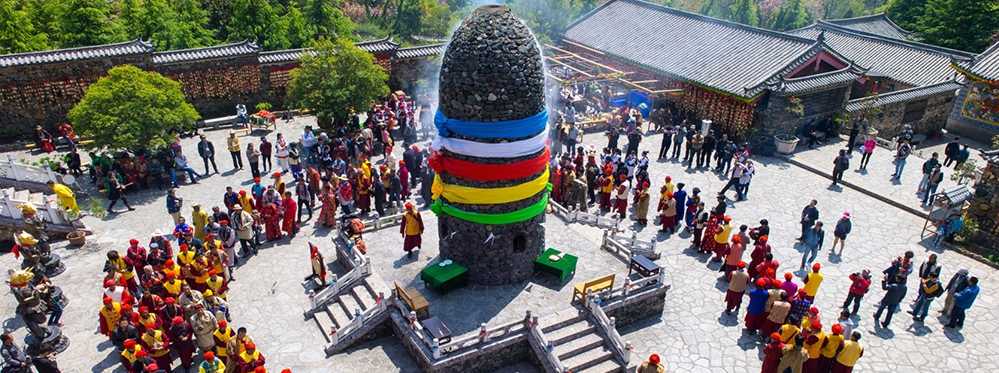
Lijiang’s temples hide in plain sight, tucked between cobbled lanes and murmuring canals. The moment you step past a weathered threshold, the clatter of the Old Town fades. Incense drifts through courtyards where pines twist toward the sky, and prayer flags flutter with a softness that seems to slow your own breath. This is not a curated silence—it’s a lived-in stillness, interrupted only by the distant chime of a wind bell or the shuffle of a monk’s sandals on flagstones.
Inside the halls, centuries-old murals watch over dim spaces lit by butter lamps. The gold leaf has flaked, but the expressions remain vivid—part guardian, part welcome. There’s no rush to decode the iconography. You can simply sit on a worn bench, letting the cool air settle around you. The stillness isn’t empty; it’s charged with presence. A cat curls on a sun-warmed step. A nun waters chrysanthemums by a stone urn. The ordinary becomes extraordinary when you’re not in a hurry.
What stays with you isn’t the grand architecture, but the quiet rhythm of devotion that asks nothing of you. It invites you to pause, to breathe alongside the smoke curling upward, and to listen—not for answers, but for the sound of your own mind settling. In Lijiang’s temples, stillness is a forgotten language that somehow you still know how to speak.
FAQ
It’s the quiet moments that make the difference—waking to roosters in a Naxi courtyard, sharing pu’er tea with a local family who still use pictographic script, or walking cobblestone streets before the crowds arrive. You’re not just observing; you’re woven into the rhythm of daily life.
Absolutely. I spent an afternoon with an elderly Dongba priest who showed me centuries-old manuscripts. He didn’t treat them as relics but as living wisdom. Through his gentle explanations, I realized how language can hold an entire worldview. That humbled me deeply.
The landscape acts as a silent teacher. Imagine watching the sun rise over Jade Dragon Snow Mountain, its peaks glowing pink while mist clings to the Black Dragon Pool. The sheer scale and beauty demand you slow down and reflect. Nature there doesn’t just surround you; it seeps into your thoughts.
Er kuai, a grilled rice cake, simple but unforgettable. I had it at a night market, charred on the outside, chewy inside, brushed with spicy bean paste and pickled vegetables. The vendor, an aunty with a warm laugh, insisted I call her ‘nai nai.’ Food there always comes with a story.
In our hyper-connected lives, we’ve lost the art of genuine connection. This trip strips away the noise. It reminds you that fulfillment comes from understanding, not just collecting destinations. It’s a reset button for the soul, steeped in human warmth and ancient rhythms.
That nervousness is the start of something meaningful. Lijiang’s embrace is gentle—the locals are incredibly patient, and the culture is enduring. Go with an open heart, and you’ll return not just with photographs, but with a piece of Yunnan etched into who you are.
Conclusion
In the heart of Yunnan, Lijiang unfolds as a tapestry woven from ancient stones and living traditions. Wandering into its old town, you step through a labyrinth of cobbled lanes, where every turn whispers centuries-old stories. The rhythm of Naxi music drifts from hidden courtyards, a high-plateau melody that seems to echo the mountains themselves. As dusk settles, the aroma of Yunnan's flavors—medicinal herbs, crisp wild vegetables, and the smoky warmth of yak butter tea—wraps around you, turning meals into memories. Here, the past is not a distant echo but a companion, walking beside you in the laughter of artisans shaping silver and the quiet pride of women weaving sunlit threads.
Beyond the town, Jade Dragon Snow Mountain rises silently, its glacial peaks a stark contrast to the colorful bustle below. Hiking its lesser-known paths, you feel the alpine hush, broken only by the wind and the distant call of a golden pheasant. That same stillness settles deeper within you at the temples, where incense curls skyward and ancient murals gaze back with serene understanding. You sit beneath a ginkgo tree, watching monks in maroon robes chant softly, and the boundary between traveler and journey dissolves. This is the soul of Lijiang—a place where culture is not consumed but absorbed, leaving you with a resonant quiet that lingers long after you've returned home.
Contact Us
Contact Person: Changhong He
Email: [email protected]
Tel/WhatsApp: 086-0888-5190152
Website: https://vip.e-baixing.com/ysh