
Solar Charging Benches Manufacturer for Smart Cities
2026-08-23
Smart cities need infrastructure that works as hard as the people using it. Solar charging benches are no longer a novelty—they're a practical solution for public spaces, campuses, and transit hubs. But finding a manufacturer that combines real durability with clean design isn't easy. That's where zemso comes in, offering solar charging benches built for the realities of urban life. In the next few minutes, you'll see why they're becoming the go-to choice for city planners.
How Durable Solar Charging Benches Are Engineered for High-Traffic Urban Spaces
At the core of these benches is a frame built from marine-grade aluminum or powder-coated steel, chosen because neither material warps or corrodes after years of rain, snow, and direct sun. The solar panel itself sits beneath a layer of tempered glass rated to withstand impacts from dropped objects and the repeated weight of seated commuters. That glass is slightly recessed into the housing, so sharp edges from keys or skateboards rarely make direct contact.
Inside, all wiring is routed through sealed channels that keep moisture and grit away from the connectors, while the USB ports are flush-mounted and protected by spring-loaded covers that snap shut automatically. Fasteners use tamper-resistant heads, and the entire surface is coated with an anti-graffiti clear layer that lets paint or marker be wiped off without damaging the finish. Heat from the panel is pushed out through small vent ports at the sides, preventing the electronics from baking on long summer afternoons.
Before any model ships, it goes through abuse testing that mimics real urban life: thousands of simulated sitting cycles, stone impacts, and temperature swings from -20°C to 60°C. The goal is not just to survive one bad winter or one rowdy crowd, but to look and function nearly the same after five or six years of constant use.
Custom Solar Bench Designs That Match Any Smart City Aesthetic
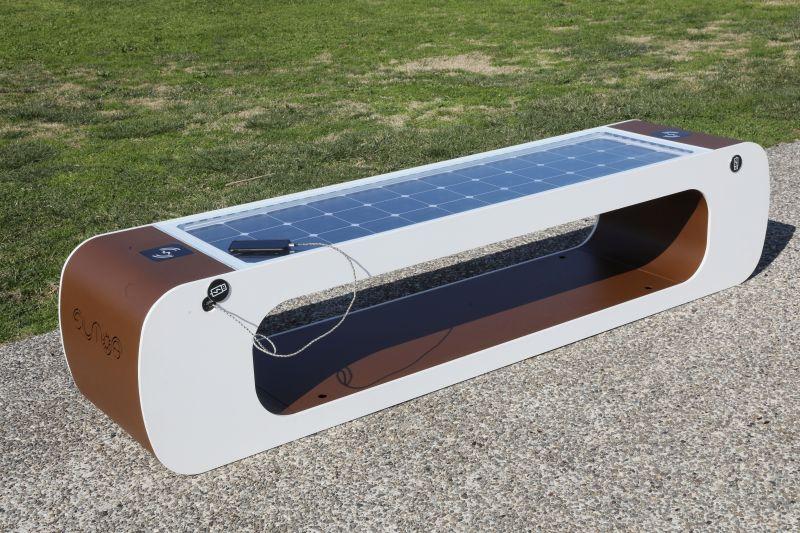
Modern urban spaces rarely settle for one-size-fits-all street furniture. A solar bench that blends seamlessly into a historic district might look out of place next to a glass-and-steel innovation hub. That's why customization goes beyond picking a color — it means adjusting seat length, backrest angle, armrest placement, and even the texture of the photovoltaic surface to suit a specific neighborhood's character. Whether a city wants a sleek, low-profile bench for a waterfront promenade or a more robust design for a busy transit corridor, the solar panels can be integrated without disrupting the overall visual language.
Material choices play a huge role in matching a smart city aesthetic. Powder-coated aluminum frames offer a clean, industrial feel and resist corrosion near coastal areas. FSC-certified hardwoods bring warmth to parks and pedestrian plazas, while recycled composite decking appeals to municipalities with strict sustainability targets. Some designs hide the wiring completely inside hollow steel legs, while others showcase a thin LED accent strip that doubles as a wayfinding light after dark. The goal is never to make the solar bench scream for attention, but to let it read as a natural extension of the surrounding architecture and public art.
Even the charging features can be tailored to local needs. A bench outside a coworking space might prioritize wireless charging pads and USB-C ports, while one near a school could include a lower-height section for kids and a small side table for backpacks. Cities with harsh winters often request heated seats or sloped surfaces that shed snow, while sun-drenched regions may opt for integrated shade canopies that still capture enough light through semi-transparent panels. By treating each installation as a unique response to its environment — rather than a product pulled from a catalog — planners can ensure the benches feel intentional, not imposed.
Battery Storage Solutions Behind Reliable 24/7 Solar Charging
Solar panels only produce electricity when the sun is shining, so without a way to store that energy, nighttime and cloudy periods would interrupt the supply. Battery storage solutions bridge this gap by capturing surplus solar power during peak daylight hours and releasing it after sunset or during low-light conditions. This creates a continuous energy loop that keeps devices, homes, or facilities running around the clock.
Modern systems typically rely on lithium iron phosphate or advanced lead-acid batteries, paired with smart charge controllers that regulate input and output. These controllers prevent overcharging and deep discharging, extending battery life while maintaining a steady voltage. Some setups also use modular battery banks, allowing users to scale capacity based on daily consumption patterns or seasonal changes in sunlight.
In practice, reliable 24/7 solar charging means fewer interruptions for off-grid cabins, remote telecom towers, agricultural sensors, and backup power systems. By sizing the battery bank correctly and incorporating a hybrid inverter, users can draw stored power seamlessly when solar generation dips. The result is a more resilient energy setup that doesn't depend on utility grids or fossil-fuel generators, even during extended bad weather.
From Parks to Transit Hubs: Real-World Deployments of Solar Benches
The first wave of solar benches appeared in parks, where their low-profile design and self-contained power made them an easy fit. A bench placed under open sky near a playground or along a walking path could charge a phone, keep pathway lights running after dusk, and run a small air-quality sensor without trenching any electrical lines. Planners liked that these units didn't compete with trees or benches for space; they simply replaced a standard seat with one that quietly gathered energy all day.
Transit hubs came next, driven by a different set of demands. Bus loops, light-rail platforms, and ferry terminals needed durable, weather-sealed furniture that could survive constant use and vandalism. Solar benches in these settings often trade wooden slats for powder-coated steel and reinforced glass, with batteries sized to keep USB ports and LED indicators alive through cloudy stretches. Riders can top up a phone while waiting, and the bench's own lighting makes the stop feel safer after dark without adding to the grid load.
Between these two poles, campuses and shopping streets have adopted solar benches as a kind of social infrastructure. A bench outside a library or a row of benches along a pedestrian mall can host free charging, local event displays, or simple Wi-Fi relays drawn from the same panel. These deployments tend to be lighter than transit versions but more connected than park ones, showing how one piece of street furniture can shift roles based on where the sun happens to land.
Integrating Solar Benches with Existing IoT and Smart City Infrastructure
Solar benches rarely operate as isolated units. Their real value emerges when they plug into the broader nervous system of a smart city—sharing data with traffic sensors, environmental monitors, and public lighting networks. A bench that tracks shade patterns or foot traffic can feed that information to nearby adaptive streetlights, helping them dim in low-use corridors or brighten near evening commuter hubs. The trick is avoiding yet another siloed gadget. Most municipal IoT platforms already run on standard protocols like MQTT or CoAP, so a well-designed solar bench should publish its telemetry without demanding a proprietary dashboard. That way, city planners see one unified map instead of a dozen disconnected apps.
Power management adds another layer to the integration story. A bench with a small lithium-ion pack isn't just charging phones; it can act as a distributed micro-storage node. During a grid stress event, a cluster of benches could shed nonessential loads or even back-feed a few watts into nearby smart poles. This requires coordination with existing energy management systems, which often use OpenADR or similar demand-response standards. The bench's controller needs to speak that language, not just report battery percentage. Some cities have started treating street furniture as virtual power plants, where each bench's battery capacity gets aggregated into a flexible reserve. It's a quiet shift from furniture to infrastructure.
Physical and digital security also can't be an afterthought. Since these benches live outdoors, their network ports and USB chargers are exposed to weather and tampering. Connecting them to a city's core IoT fabric means a compromised bench could become a pivot point for lateral attacks. Good integration insists on hardware root-of-trust chips, signed firmware updates, and segmented VLANs for street-level devices. The bench might also need to support local decision-making when connectivity drops—caching sensor readings or limiting charging to protect the battery. In practice, the smoothest integrations happen when the bench vendor treats the city's existing platform as the source of truth, pushing updates and pulling rules from that environment. That kind of humility in design makes the difference between a gadget and a genuinely native smart city component.
Modular Construction Techniques That Cut Long-Term Maintenance Costs
Traditional building methods often bury pipes, wiring, and structural connections behind layers of finish materials, making every repair a small demolition project. Modular construction flips that logic by assembling large sections of a building in controlled factory conditions, then joining them on site with a fraction of the field-made connections. Fewer on-site joints means fewer places for water intrusion, thermal bridging, and premature wear—three of the biggest drivers of long-term upkeep.
The real savings show up years later. Because modules are built to precise tolerances, access panels line up, mechanical chases stay clear, and replacement parts match from day one. Instead of cutting into drywall to trace a leak, maintenance crews can often reach the problem through a planned opening or swap out a standardized component without custom fabrication. That predictability trims labor hours and keeps small issues from turning into expensive structural repairs.
Another overlooked advantage is material consistency. Factory production allows for repeated use of proven assemblies—flashings, sealants, insulation details—that get refined over hundreds of units. Site-built projects depend on varying labor skills and weather conditions; modular components leave the factory with those weak points already sealed and tested. Over a 20- or 30-year ownership period, that consistency translates into fewer envelope failures, lower repainting and resealing costs, and less disruptive maintenance for occupants.
FAQ
Look for vandal-resistant construction, a replaceable LiFePO4 battery, and dual USB-C plus wireless charging. The electronics should carry an IP65 rating, and the frame needs an anti-graffiti coating to stay clean in high-traffic areas.
Marine-grade aluminum frames and sealed compartments keep the internals dry. The tempered solar glass is angled to shed snow, while optional heating elements around the ports prevent ice buildup. Salt-spray testing and UV-stable powder coating handle coastal and desert conditions.
Yes, each unit is built to order. You can specify two, four, or six USB ports, add Qi wireless pads, or integrate air quality sensors and Wi-Fi. The solar array and battery capacity are scaled to match those loads.
Very little. The panels shed light debris naturally, though a wipe twice a year helps in dusty regions. Remote diagnostics flag battery or controller issues, so maintenance crews only make a trip when something actually needs attention.
With the pre-cast base option, two workers can anchor and wire a bench in under three hours. There is no deep excavation, and we supply a temporary barrier kit to keep pedestrians safe while the area is being finished.
A range of powder-coat colors, wood-look slats, and recycled plastic finishes are available. You can also emboss a city logo or add low-energy LED accent lighting that switches on automatically at dusk.
They use open protocols like MQTT and LoRaWAN, so integration is straightforward. The bench can report usage, battery health, and environmental readings to any dashboard that accepts standard open data formats.
Conclusion
Modern solar charging benches are built to withstand the relentless wear of high-traffic urban environments, from reinforced seating surfaces and anti-vandal fasteners to weather-sealed electronics that shrug off rain, snow, and intense UV exposure. A forward-thinking solar bench manufacturer pairs this rugged engineering with custom design options, allowing cities to match benches to local architectural styles, public art programs, or branded smart-city initiatives without sacrificing performance. Hidden beneath each seat, advanced battery storage systems ensure that surplus daytime energy is preserved for overnight charging or cloudy days, reliably powering devices around the clock. Real-world deployments across parks, university campuses, and transit hubs prove that these benches do more than charge phones—they become natural gathering points and wayfinding landmarks. By integrating with existing IoT networks, solar benches can transmit usage data, air quality readings, or Wi-Fi hotspots, turning passive street furniture into active nodes of urban intelligence. Crucially, their modular construction lets maintenance crews swap out individual solar panels, batteries, or charging ports in minutes, slashing long-term service costs and keeping benches operational for a decade or more.
Beyond the technical specs, the real value of a specialized solar charging bench manufacturer lies in tailoring each unit to the exact rhythms of city life. For a busy downtown plaza, that might mean high-capacity batteries and fast-charging ports that handle hundreds of daily users. For a quiet neighborhood park, a lower-profile bench with warm wooden accents and a gentle ambient light strip fits naturally into the landscape. The best manufacturers work closely with urban planners to map sun exposure, foot traffic patterns, and existing smart poles or sensors, ensuring seamless integration rather than a bolted-on afterthought. This collaborative approach avoids the common pitfall of identical, cookie-cutter solar benches that feel foreign to their surroundings. Instead, each bench feels deliberately placed, offering a reliable charge while encouraging people to pause, rest, and reconnect—both with their devices and with the public space around them. The result is infrastructure that works quietly every day, delivering on the promise of a truly connected, sustainable city.
Contact Us
Contact Person: Leo
Email: [email protected]
Tel/WhatsApp: +86 18901905138
Website: https://www.zemsogroup.com/