

Top 10 Double Jacketed Gaskets Suppliers in China Worth Considering
2026-11-02
If you've ever tried to source double jacketed gaskets from China, you know the problem: hundreds of suppliers promising the same thing, but few deliver the consistency you actually need. Dig a little deeper, however, and a handful of names start repeating for all the right reasons. One that keeps surfacing in client feedback is Kaxite, a manufacturer quietly building a reputation for tight tolerances and honest material specs. Before you shortlist your next vendor, here are ten double jacketed gasket suppliers in China that deserve your attention in 2025.
When a Gasket’s Outer Shell Does the Heavy Lifting
In many gasket designs, the inner core gets all the credit, but there are situations where the outer shell is doing nearly all the sealing work. Take a spiral wound gasket with a solid metal outer ring, for instance. That ring isn't just there for centering—under high bolt loads, it can deform slightly to bridge surface irregularities, while the softer filler barely has to engage. The shell becomes the pressure boundary, not just a protective jacket.
This dynamic is especially visible with jacketed gaskets used in heat exchangers. The metal jacket, often only a few millimeters thick, must handle both the mechanical compression and the corrosive media. If the jacket develops a pinhole, the entire seal fails even if the inner filler is perfectly intact. That's why shell thickness and material selection matter more than the filler's compressibility in these applications—the shell isn't supporting the load; it is the load.
A less obvious case shows up in elastomeric gaskets with a PTFE envelope. The elastomer core provides the bounce, but the PTFE shell does the chemical barrier work. Here, the outer layer must withstand chemical attack and temperature swings without cracking, because any breach exposes the core to immediate degradation. Engineers who treat the shell as just a cover often end up with premature failures that trace back to that thin outer layer trying to do too much with too little support.
Chinese Workshops Quietly Supplying Global Refineries
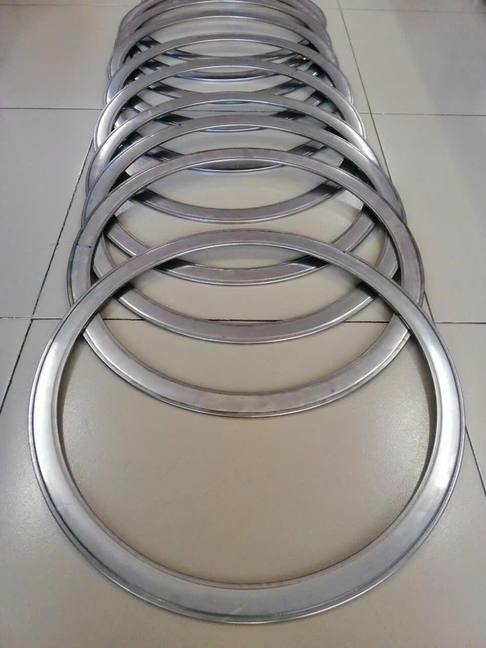
In industrial districts across Zhejiang and Hebei, small fabrication shops turn out valve bodies, pump casings, and heat-exchanger tube sheets destined for refineries in the Middle East, Southeast Asia, and Latin America. These are not the branded equipment makers that dominate trade show floors, but anonymous subcontractors working from emailed drawings and tight deadlines. Their output moves through trading companies and consolidators, so the final buyer often has no idea where the steel was actually shaped.
The economics are hard to ignore. A workshop with three dozen workers and a handful of CNC lathes can quote a replacement impeller or a set of tube plugs for a fraction of what a Western machine shop would charge, even after shipping and middlemen take their cut. Refinery maintenance budgets, stretched by downtime costs, quietly favor these sources. The parts are not always exotic; much of it is everyday iron and stainless work, but the reliability of delivery and the willingness to handle small batch orders keep the orders flowing.
Quality control varies, and that is where the quiet part becomes risk. Some shops have invested in spectrometers and pressure-testing rigs, while others rely on a supervisor with a micrometer and a good eye. Refinery procurement managers rarely discuss this tier of the supply chain in public, but it has become a structural part of how turnarounds get completed on time and under budget.
The Metallurgy Behind a Leak-Free Seal
Most people picture a gasket as a simple ring of rubber or cork, but the real story happens at the microscopic level. The metals used in high-performance seals are rarely pure; they are carefully tuned alloys where grain size, phase distribution, and surface hardness dictate how well the material conforms to flange irregularities. A seal that works flawlessly at room temperature might leak when thermal cycling causes one alloy to expand faster than its mating surface, so selecting a metal with a compatible coefficient of thermal expansion is just as important as its tensile strength.
Manufacturers manipulate more than just composition. Cold working and heat treatment can close up porosity, align grain boundaries, and create a spring-like resilience that keeps the seal tight even after thousands of pressure cycles. For instance, a soft annealed copper gasket deforms to fill microscopic valleys in a flange, but it also work-hardens under repeated compression, gradually losing its ability to rebound. That is why many industrial systems shift to austenitic stainless steels or nickel-based alloys, which retain their mechanical properties across a wide temperature range without becoming brittle.
Surface finish on the metal itself plays an equally quiet role. A mirror-polished seal may look perfect but can actually trap gases in micro-pockets, while a controlled roughness helps the gasket bite into the flange and maintain a labyrinth path that discourages leakage. The real art is balancing hardness against ductility: too hard and the seal cracks under bolt load; too soft and it extrudes out from between the flanges. This is why metallurgists spend years fine-tuning the exact temper and grain structure for a specific sealing environment, whether it is liquid hydrogen at cryogenic temperatures or superheated steam in a power plant.
Why ‘Cheapest’ Rarely Survives the First Shutdown
The appeal of the lowest bid is easy to understand: it promises immediate savings and a clean line on the budget sheet. But in industrial and manufacturing settings, that initial price advantage often vanishes the moment systems are pushed to their limits. A cheap component, machine, or service contract rarely carries the engineering margins needed for sustained operation. When the first unexpected shutdown hits—a power dip, a thermal spike, or a sudden load change—the bargain solution is usually the first to fail, taking production down with it.
Shutdowns expose the hidden costs of under-specified equipment and under-scoped support. A motor that runs fine at 80% load but stalls at 110% leaves you stranded exactly when you need output the most. A service provider who promised round-the-clock response but lacks local parts inventory becomes a liability the moment a critical line stops. The real price of “cheapest” is paid in lost throughput, emergency overtime, and hurried replacements—expenses that rarely appear on the purchase order but dominate the cost of the first major outage.
What survives the first shutdown is not the part with the lowest sticker price, but the one engineered for the worst-case scenario. That means proper thermal ratings, conservative duty cycles, accessible spares, and a supplier who treats uptime as part of the product. Choosing based on resilience rather than initial cost doesn’t just avoid failures; it changes the economics of downtime from a recurring crisis into a rare, manageable event.
How to Spot a Supplier That Actually Stocks Inventory
A supplier's website can tell you a lot before you ever send an email. Look for real-time stock counts, not vague phrases like "large quantities available." If they show a live counter or let you enter a zip code to check local availability, that's usually a good sign they run a tight warehouse operation rather than drop-shipping from a third party.
Call them and ask for a bin location or shelf number on a specific SKU. A supplier that actually holds inventory can walk to a rack and confirm the item is physically there within a minute or two. If they hesitate, put you on hold for ten minutes, or say they need to "check with the warehouse," that often means the stock lives in someone else's building.
Pay attention to how they handle backorders and lead times. Honest stock-holding suppliers will tell you flat out when something is out of stock and give you a concrete restock date. If every item seems to have a fuzzy two-to-three-week lead time, chances are they're ordering from the manufacturer only after you place your order.
Names That Keep Appearing in Plant Maintenance Logs
Flip through any well-worn maintenance binder and a handful of names start to feel like old friends. There’s the technician who gets called for every stubborn pump rebuild, penciled in beside dates stretching back years. Then there’s the operator whose initials show up again and again on lubrication checks, almost always with a small note about a noise that “wasn’t there last week.” These aren’t accidents. Repeated names often mark the people who actually notice small changes before they become breakdowns.
Sometimes a name recurs because a single person holds tribal knowledge about a finicky piece of equipment. Other times it’s less flattering: the same signature appears next to incomplete inspections or hastily closed work orders. Supervisors who read logs closely learn to separate the two. A name that shows up alongside detailed observations, follow-up notes, and parts used is worth more than a perfect attendance record. When that person moves on, the gap in the logs is immediate.
There’s also the quiet pattern of names appearing in clusters around certain seasons or shifts. One name might dominate every winter entry for steam trap repairs. Another only shows up on third-shift vibration readings. Logs don’t list job titles, but repeated names reveal who is really touching the equipment. Paying attention to those repetitions isn’t about blame. It’s about knowing whose eyes and ears to trust when a machine starts talking in a different tone.
FAQ
A genuinely worthwhile supplier goes beyond copying standard drawings. They should offer engineering input on jacket thickness, filler compression, and flange compatibility for your specific pressure class. Look for shops that laser-cut the metal jackets instead of relying on older shearing methods, as this reduces burrs and improves sealing consistency. One practical sign is whether they ask about your operating temperature range and chemical exposure before quoting, rather than just giving a one-size-fits-all price.
The reliable ones use CNC forming for both inner and outer rings, then verify dimensions with coordinate measuring machines or at least calibrated profile projectors. Batch records should include actual measured thickness at the sealing face, not just the nominal value. Some plants in Jiangsu and Zhejiang have adopted inline laser scanning to detect out-of-tolerance jackets before filler insertion.
Flexible graphite is the workhorse because it handles high temperatures and seals under moderate bolt loads. PTFE fillers appear where chemical resistance is paramount, especially in strong acids or high-purity lines. Ceramic or mica fillers are less common but show up in extreme heat exchangers. The filler choice directly controls leak tightness, so a supplier who understands filler density and recovery rates will outperform one who simply stuffs any graphite sheet into the jacket.
They shine in heat exchangers, boiler handholes, and flanged connections with uneven surfaces or wide temperature swings. Unlike spiral wound gaskets, they handle frequent thermal cycling without spring-back loss because the metal jacket protects the filler from direct exposure. Refineries often prefer them for steam and hydrocarbon lines where a small leak can quickly escalate.
ISO 9001 is the baseline, but not sufficient by itself. Look for API 6A or API 17D approval if you serve oil and gas, or TA-Luft certification for fugitive emission compliance in chemical plants. Also check whether the supplier can provide third-party test reports for compression set, stress relaxation, and sealability under your specific media. A plant with an in-house lab for hot compression testing usually has stronger process control than one relying on external labs.
Yes, many can, but you need to filter for shops with actual engineering capacity. Provide a detailed drawing with flatness tolerances and specify whether you need vent holes, passivation, or a special jacket alloy like Inconel or Monel. A capable supplier will run a finite element analysis or at least a prototype batch for pressure testing before series production. Avoid factories that immediately accept any dimension without asking about operating conditions—that often leads to field failures.
The biggest pitfall is inconsistent filler density between batches, which lowers sealability after a few thermal cycles. Ask for density measurement data on each batch, not just a certificate of conformance. Another pitfall is hidden corrosion on low-grade stainless steel jackets, so specify 316L rather than 304 if your environment has chloride traces. Finally, clarify packaging requirements upfront: bare metal gaskets can rust in ocean transit if not protected with VCI paper and sealed bags.
Conclusion
When double jacketed gaskets go into a heat exchanger or flange joint, the outer shell isn't just trim—it carries the sealing load, flexing under thermal cycles while the filler absorbs compression. China's better workshops have quietly become a default source for refiners in the Gulf, Southeast Asia, and Latin America, not because they advertise loudly, but because their gaskets keep showing up in maintenance logs alongside brands that cost twice as much. The difference usually sits in metallurgy: a 316L jacket with proper cold work and a graphite or PTFE filler cut to the right density won't weep after a few shutdowns. The cheapest tender often fails precisely there—thin jackets, recycled stainless, or filler that disintegrates once steam hits it. Plants learn to ask for mill certificates, traceability batch numbers, and proof of PMI testing rather than a polished catalogue.
Spotting a supplier that actually stocks inventory means calling on a Tuesday and asking for 300 pieces of 24-inch 150# with 316L jacket and flexible graphite filler—if they promise delivery in a week without checking a warehouse screen, walk away. The names that keep reappearing in plant maintenance logs across Rotterdam, Singapore, and Houston aren't always the biggest exhibitors at valve expos. They tend to run tight in-house tooling, keep common sizes on the shelf, and treat dimensional tolerance as a floor, not a ceiling. For anyone shortlisting double jacketed gasket suppliers in China, the real filter is shutdown survival: one unplanned outage erases years of unit-price savings, so the top ten worth considering are the ones that understand that math better than their sales pitch.
Contact Us
Contact Person: Kaxite
Email: [email protected]
Tel/WhatsApp: 0086-574-87527771
Website: https://www.seal-china.com