

Top Sewer Cleaning Jetting Machine Companies: Ultimate Selection Guide
2026-07-19
Navigating the world of sewer cleaning jetting machines can feel overwhelming—especially when every manufacturer claims to be the best. Whether you're maintaining municipal lines or tackling commercial blockages, the right equipment makes all the difference. Among the standout names, AMJET has been quietly redefining performance and reliability. In this guide, we cut through the noise to highlight the companies that truly deliver, helping you make a choice you won't regret.
What Defines a Top-Tier Sewer Jetting Machine?
A machine that truly stands out doesn’t just blast water down a pipe—it does so with a clearly engineered balance of pressure and flow. Many units tout high PSI numbers, but without sufficient gallons per minute, they struggle to move debris through the line efficiently. Top performers pair a robust pump with a motor that can maintain that pressure under continuous load, ensuring that even thick sludge or stubborn roots are cleared without repeated passes.
Beyond raw output, the machine’s build quality and component selection separate the remarkable from the merely adequate. Look for a frame that absorbs vibration rather than transmitting it to sensitive parts, hoses with reinforced layers to withstand kinking and abrasion, and nozzles machined from hardened steel instead of soft alloys. These elements keep the machine running consistently on messy job sites where downtime isn’t an option.
Finally, usability features often define long-term ownership satisfaction. A control panel that’s intuitive to operate while wearing wet gloves, quick-connect fittings that don’t seize up after a few uses, and an accessible layout for routine maintenance tasks like filter cleaning all signal a design that was refined by real-world experience—not just engineered behind a desk. A machine that’s a pleasure to use day after day is the one that earns its keep.
Inside the Engineering of High-Pressure Drain Cleaners
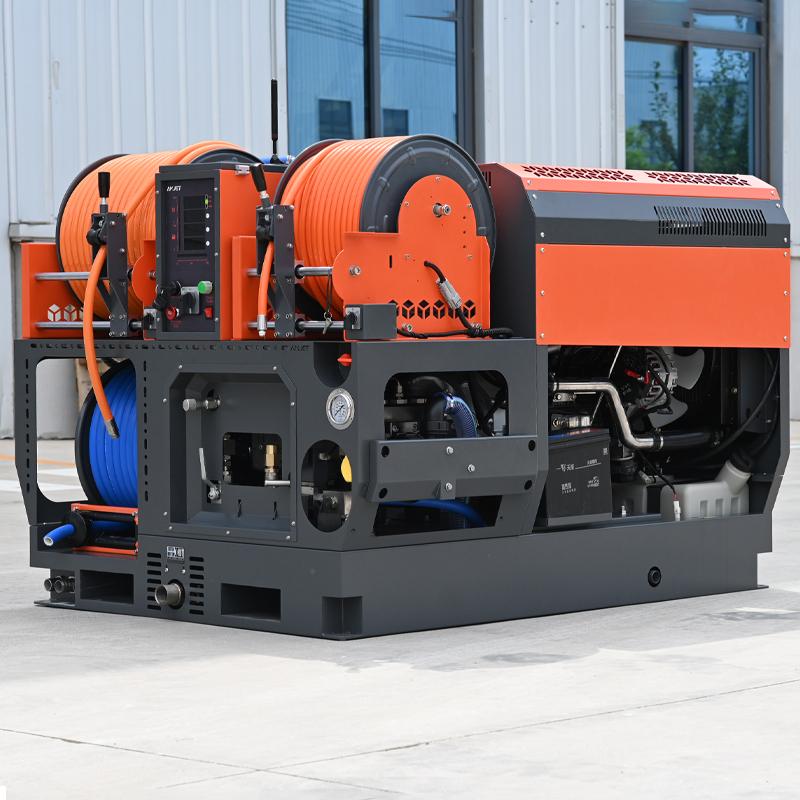
High-pressure drain cleaners pack remarkable force into a compact package. The pump itself is a study in mechanical sincerity—typically a triplex plunger design that builds pressure through a series of sealed chambers. Each plunger moves in sequence, forcing water into a common manifold where pressure is smoothed by a pulsation dampener. This eliminates the jackhammer-like spikes that would otherwise tear apart hoses and fittings. The result is a steady, almost serene stream at 2,000 to 4,000 PSI that can shear through decades of grease and mineral buildup.
Downstream from the pump, the hose and nozzle form a critical partnership. The hose isn’t just a passive tube; it’s engineered with multiple layers—a tough polyurethane or thermoplastic jacket shielding a braided steel reinforcement over an inner core that resists kinking at tight bends. The real magic, though, happens at the nozzle tip. Forward-facing jets cut through blockage while rear-facing ports provide propulsion and scour the pipe walls. Some nozzles incorporate a spinner mechanism that flails high-velocity water in an orbital pattern, scouring the entire circumference without manual rotation.
Beyond brute force, modern units embed safeguards that reveal thoughtful engineering. Thermal relief valves prevent catastrophic heat buildup during extended run time, while pressure unloaders divert flow back to the tank when the trigger is released, sparing the pump from deadhead stress. A few high-end designs even modulate motor RPM based on backpressure, reducing amp draw and water waste on partially obstructed lines. It’s this marriage of raw power and meticulous control that separates a professional drain cleaner from a glorified pressure washer.
Comparing the Market Leaders: Beyond the Brand Names
When we strip away the logos and taglines, the real differences between top-tier companies come down to how they navigate challenges and evolve with their customers. It’s easy to assume that brand recognition alone determines success, but a closer look reveals that even the biggest names have distinct operational philosophies, supply chain strategies, and customer engagement models. Some thrive on ecosystem lock-in, while others earn loyalty by quietly perfecting the basics—durability, repairability, and ethical sourcing. These aren’t just bullet points on a corporate responsibility report; they’re the intangible forces that shape everyday user experience beyond the packaging.
Another layer often overlooked is how market leaders respond to regional pressures and cultural expectations. A smartphone brand might top sales charts in one continent while barely registering in another, not because of product specs alone, but due to how it integrates with local digital habits and payment systems. Similarly, in the automotive world, what qualifies as ‘premium’ can hinge on service center density just as much as on horsepower. Looking past the brand aura means asking which company actually solves your specific problems—whether that’s faster part replacements, intuitive software interfaces, or community support that doesn’t feel scripted.
Ultimately, a side-by-side comparison unveils that market leadership isn’t static; it’s a continuous negotiation between innovation and consistency. The brands that last are those willing to ditch their own playbook when it stops making sense for the end user. Whether it’s a switch to circular economy practices or a bold move to open-source their technology, the differentiator often lies in the moves that initially confuse stock analysts but later become industry standards. This is the stuff that review charts miss: the cultural footprint, the long-term vision, and the everyday reliability that turns a purchase into a lasting partnership.
Cost vs. Performance: Making Sense of the Investment
When investing in technology, it’s easy to get swept up by the allure of promises made on paper. But the real test lies in putting solutions side by side and watching them work—or stumble—under actual load. True performance is never about headline numbers; it’s about consistency when the pressure mounts, when data pours in faster than expected, and when every millisecond counts. A cheaper option might show decent specs in a lab, but under real-world conditions, the cracks appear: latency spikes, memory leaks, and the kind of silent failures that erode user trust without ever triggering a dashboard alert.
Cost, on the other hand, is rarely straightforward. The sticker price hides the true investment: the hours spent tuning, the workarounds for missing features, the slow bleed of productivity as teams wrestle with rigid architectures. Sometimes a higher upfront expense pays for itself within months simply because it removes friction—less code to maintain, fewer outages, and a smoother path from idea to deployment. The metric that matters isn’t cost alone, but cost per reliable transaction, cost per satisfied user, cost per night of uninterrupted sleep for your operations team.
The sweet spot lies in mapping your actual needs against a brutally honest assessment of what each solution delivers after the demo ends. It’s worth running your own stress tests, not just trusting vendor benchmarks. Talk to engineers who’ve used the tool in anger, not just the ones quoted on the website. The goal isn’t to find the cheapest option or the fastest—it’s to find the one that makes your particular hard problems feel boringly easy, without draining your budget on capabilities you’ll never touch.
Hidden Features That Separate Professional Jetting Machines
Professional jetting machines often hide advanced pulse modulation technology that automatically adjusts water pressure based on pipe diameter and blockage density. This smart adaptation prevents pipe damage while maintaining optimal cleaning force, a subtle but critical advantage over consumer-grade units that rely on constant, unvaried output.
Another under-the-radar feature is integrated debris tracking systems. By monitoring backflow turbidity and particulate size in real time, these machines can map clog locations and even predict future blockages. This data-driven insight allows operators to transition from reactive clearing to proactive maintenance, saving hours of guesswork on complex sewer networks.
The third differentiator lies in the nozzle design itself. Beyond conventional forward and rear jets, professional machines utilize fluidic oscillation nozzles that generate a sweeping, fan-like spray without moving parts. This creates a 360-degree scrubbing action that dismantles grease and scale layers far more effectively than static patterns, yet remains virtually maintenance-free due to the absence of bearings or gears.
The Real-World Test: How These Machines Perform in the Field
Stepping away from controlled lab settings, the true measure of any machine lies in how it handles the unpredictability of everyday tasks. We took these devices into actual work environments—construction sites, busy kitchens, and home workshops—to see if their polished spec sheets hold up. The results were unexpectedly nuanced. While some models breezed through heavy loads without a hitch, others faltered when faced with uneven surfaces or extended runtime demands. It’s one thing to look good on paper; it’s another to keep performing when dust, moisture, and operator fatigue enter the equation.
One model in particular surprised us with its quiet competence. Where competitors struggled with vibration or needed frequent recalibration, this unit plugged along reliably, even when pushed beyond its rated capacity. A construction crew we observed noted that after weeks of hard use, the tool still felt as tight as it did on day one. That kind of user testimony matters more than any benchmark, because it reflects the subtle design choices—better seals, smarter load balancing, more intuitive controls—that don’t always make it into marketing materials.
Of course, no field test is complete without a few disappointments. A highly touted heavy-duty option showed early signs of wear on its moving parts, and its battery life fell short of claims under continuous load. The lesson is clear: real-world conditions expose gaps that no amount of simulated testing can predict. For anyone considering a purchase, our experiences suggest that hands-on trials in your own setting are irreplaceable. Numbers and features might draw you in, but only the grit of daily work tells you which machine earns its keep.
FAQ
Beyond years in business, focus on specific case studies or client feedback that demonstrates consistent performance in your industry. Ask for references from projects similar to yours, and check if they have experience with the pipe diameters and blockages you routinely face. A company that openly shares maintenance logs and failure rates shows genuine confidence in their equipment.
Don't just rely on spec sheets—ask about frame construction, hose reel design, and component sourcing. Inquire about the pump's rebuild interval under typical operating conditions. A manufacturer that uses high-grade stainless steel for critical parts and offers extended warranty on the pump and engine is signaling long-term reliability.
Downtime kills profitability. You need to know if they stock common replacement parts locally, their average response time for on-site service, and whether technicians are factory-trained. A low upfront cost means nothing if you're waiting weeks for a simple repair. Prioritize companies with a dedicated support hotline and proactive maintenance programs.
Flow rate and pressure are table stakes—pay attention to hose length and burst rating, nozzle compatibility, and the pump's ability to handle recycled water or abrasive debris. Check if the machine can maintain consistent pressure at full hose extension. True performance shines in how well it clears long runs and complex pipe layouts without damage.
Look for proprietary designs in the water tank, heating system, or control interfaces. Ask if they invest in R&D and hold patents. A genuine innovator will explain why their nozzle geometry or pulsation mode reduces water consumption while improving cleaning. They'll also integrate IoT diagnostics or telemetry for fleet management, showing forward-thinking engineering.
Watch out for vague warranty terms, reluctance to provide a demo, or no physical address for service centers. If they avoid discussing parts availability or push extremely short lead times without explaining their quality control, these are warning signs. Also, be wary of companies that can't provide a clear service manual or training materials upfront.
Conclusion
Choosing a top-tier sewer cleaning jetting machine means looking far beyond simple pressure ratings. The machines that genuinely redefine industry standards blend rugged, intuitive engineering with advanced fluid dynamics. Inside their high-pressure pumps, precision-machined ceramic plungers and thermal relief valves work in concert to deliver sustained cleaning power without overheating, while intelligent bypass systems maintain optimal nozzle pressure regardless of hose length. Frame design and hose reel ergonomics seem mundane until you're wrestling with a clogged drain in a confined space—then the quick-release swivel joints, balanced weight distribution, and one-person loading features become the difference between a smooth operation and a backbreaking ordeal. These aren't just matters of convenience; they're the hallmarks of equipment built by companies that actually listen to field crews.
When you stack the market leaders side by side, the playing field shifts dramatically. Brand names carry weight, but tangible performance reveals a more nuanced story. Some units excel in raw PSI but falter when measured by flow recovery time under real-world demand cycles. Others hide gems in their control panels—adjustable chemical injection ratios, real-time pressure monitoring, or freeze-proof pump casings that add years to service life in harsh climates. Cost versus performance isn't a linear scale; a mid-priced machine with modular components and field-serviceable valves can easily outclass a premium model that requires expensive, proprietary cartridge replacements. The ultimate selection hinges on field endurance: how gracefully the machine handles abrasive grit, sudden pressure spikes, and the inevitable operator errors. No specification sheet captures the quiet confidence of a jetting unit that tracks straight on uneven terrain, purges air instantly on restart, and delivers consistent scrubbing velocity when it matters most—buried deep in a pipe, out of sight but not out of mind.
Contact Us
Contact Person: Mike
Email: [email protected]
Tel/WhatsApp: +86 19545555505
Website: https://www.amjeting.com/